
 We all want to feel inner peace. We look for it throughout our entire lives, as being at peace allows us to dream and to actually follow those dreams. When we are at peace with ourselves, we are more understanding and loving towards others, we are able to embody the concept of being One, and therefore we create deeper and more meaningful connections with family, friends and people in general.
Confidence is very important, too. When we have confidence in our inner self, we are more prepared to take risks to advance, and we feel focused and motivated to face challenges. Confidence is believing in our own abilities and skills to do what we want and need to do in order to achieve a good quality of life, not only in the physical world, but also in the spiritual realms of existence.
I want to share a few ways of creating inner peace and confidence in this new year. Just by committing to one of these suggestions, you will see transformation happening in your soul and body.
- Change habits
We are all attached to habits that in the long run do not allow us to advance in our inner self journey. In this sense, observing one self in order to identify a few of those habits is advisable. A good way to do this is to sit down in silence and review your daily habits one by one, being very honest with yourself.
Once you have identified those habits you want to change or completely delete from your life, start with the process of substitution. Go little by little and be realistic, which means doing what you are prepare to do, without overwhelming yourself, because implementing new habits should be easy. If you are going to get stressed trying to make a lasting change, not doing it at all is better. Your emotional and mental health come first.
“If we could change ourselves, the tendencies in the world would also change.” ~ Ghandi
- Start a daily meditation practice
 Meditation has been found to have numerous scientific benefits. For example, it reduces stress, improves concentration, boosts creativity, and increases happiness. Meditation affects our mental health in a positive manner, decreasing anxiety and depression, improving sleep, and enhancing self-awareness
The benefits of meditation touch our physical being as well. Research shows that it helps lower blood pressure, thereby improving cardiovascular health and strengthening our immune system.
There are numerous types of meditation. However, when starting it is better to follow guided meditations, as this kind of meditation allows us to understand what we are really doing and to enter into the practice with ease. And don’t overwhelm yourself! Set an achievable time, like 5 to 10 minutes per day, to start. Once you have learned to meditate for this length of time comfortably, you can increase it.
“The energy of the mind is the essence of life.” ~ Aristotle
- Cultivate a positive attitude
A positive attitude has been linked with increased happiness, health and success in all areas, including the spiritual realm. Make an effort to be more positive this year. This does not mean you should avoid negative thoughts and feelings. Instead, acknowledge them and aim to elevate yourself by seeing them in another light. Find solutions from there.
“The happiness of your life depends upon the quality of your thoughts.” ~ Marcus Aurelius
- Practice living in the now
Making a conscious effort to focus on the present involves attention. We have to control our attention, observe where we are placing it and bring it to the now. It is normal to think about the past or the future, but remember that the past is gone and the future never really arrives, we always live it in the present. Sense, live and enjoy every moment of your day. Try this approach and see what happens.
“The present moment is filled with joy and happiness. If you are attentive, you will see it.” ~ Thich Nhat Hanh
- Practice gratitude
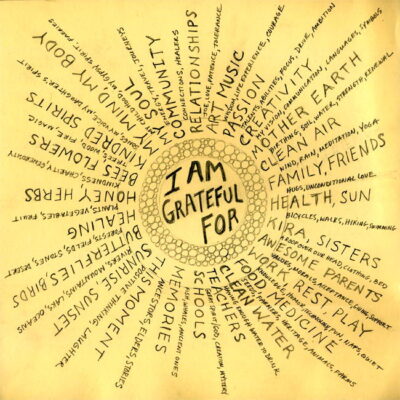
Gratitude is a powerful feeling, because, for me, it is love in action. Make it a habit to focus on the things you are grateful for, big and small. You could start a gratitude journal, which I am doing this year. I have created my own journal and my aim is to write in it every day. You can also take a few moments each day to reflect on the things you are grateful for.
Science has proven that feeling and expressing gratitude impacts our emotional and mental health in a positive way. In fact, the HeartMath Institute has discovered that, “Gratitude releases a powerful, self-rewarding feel-good neurotransmitter in the brain.” Furthermore, they have measured the heart rhythms of people when they feel gratitude and appreciation, and the results show a coherent rhythm: in other words a coherent heart.
“Gratitude is not only the greatest of virtues, but the parent of all others.” ~ Marcus Tullius Cicero
- Get organized
While this advice might not seem to be “spiritual”, nourishing our inner self requires discipline, will and order. Organisation in certain areas of our lives brings us joy and a sense of freedom.
This same idea should be applied to our spiritual practices, meaning that it is important to create a routine and ways of tackling such practices. For example, every morning I start my day with a short meditation and connection to the Source exercise, then I say a few decrees and I end with a short positive visualisation of the activities of the day.
Our external life needs organisation, too. One of the things I do the first month of the year is reorganise my closet, and any place at home in need of order. By doing so, I am creating space not only in my physical surroundings, but in my mind and in my heart. I encourage you to get rid of anything that bothers you and is only collecting dust. Organisation is liberation!
“Organization is what makes the impossible possible, the easy easy, and the difficult manageable.” ~ Zig Ziglar
About the Author:

Veronica Sanchez De Darivas is Chilean-Australian, now living in the UK and a proud mother of teenage twins. A spiritual awakening teacher, bestselling author, pineal gland (third eye) activator and Certified Instructor for the Cyclopea Method, Veronica is currently the only instructor in the world teaching the Cyclopea Method in English.
 Brian was just a kid when he first saw the movie Good Will Hunting and wasn’t thinking about therapy or his mental health. The 29-year-old engineer was mostly just fascinated by stories about repressed geniuses and Matt Damon’s background story of being a Harvard dropout. He also thought it was pretty rad that the original script was intended to be a spy-thriller.
 What happens when you close down a city street to cars? More people do non-driving things, like walking, biking, strolling, skating and frolicking in the space normally reserved for motor vehicles. Car-free advocates would say that as greenhouse gas emissions and traffic violence go down, happiness and connection go up — it’s hard to connect with your neighbors while ensconced in two tons of steel.
 A few months ago, I was introduced over email to a consultant, who I’ll call Brad. The person who made the introduction thought Brad would make a good contributor to Harvard Business Review, where I work as an editor. I receive a good number of these introductions, and when this one came in, I was particularly overwhelmed with requests. Brad asked if we could get on the phone to talk. I courteously declined and let him know that an editor would be in touch about the draft he submitted.
 In Sidetracked: Why Our Decisions Get Derailed, and How We Can Stick to the Plan, Francesca Gino, an associate professor at Harvard Business School, explores a range of fascinating subjects, including how emotions influence decisions and the often-thorny matter of understanding the perspectives of others. Blending social science and real-world examples, Gino’s book also highlights the science of gratitude.

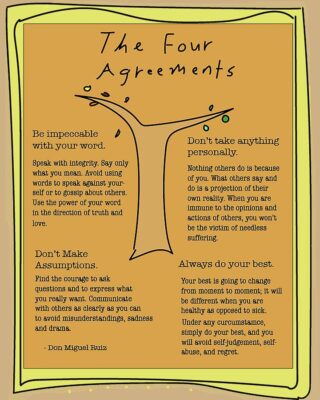 Spiritual teacher Don Miguel Ruiz brought The Four Agreements into Western awareness. A new thought author versed in ancestral knowledge, Ruiz says the agreements come from Toltec wisdom. The Toltecs were a pre-Hispanic culture living in central Mexico, talented artists and builders as well as warriors.
 Recovering from a happy childhood can take a long time. It’s not often that I’m suspected of having had one. I grew up in Norman, Oklahoma, a daughter of immigrants. When I showed up at college and caught sight of other childhoods, I did pause and think: Why didn’t we grow our own tomatoes? Why did I watch so many episodes of “I Dream of Jeannie”? Who is Hermes? What is lacrosse? Was my childhood a dud? An American self-inspection was set in motion. Having lived for more than forty-five years, I finally understand how happy my childhood was.
 In the run-up to marriage, many couples, particularly those of a more progressive bent, will encounter a problem: What is to be done about the last name?
 In a forthcoming study, Kristin Kelley, a doctoral student working with Powell, presented people with a series of hypothetical couples that had made different choices about their last name, and gauged the subjects’ reactions. She found that a woman’s keeping her last name or choosing to hyphenate changes how others view her relationship. “It increases the likelihood that others will think of the man as less dominant—as weaker in the household,” Powell says. “With any nontraditional name choice, the man’s status went down.” The social stigma a man would experience for changing his own last name at marriage, Powell told me, would likely be even greater.