
 What’s the point of networking if not to get other people to like you? Sure, you need new contacts to see you as interesting, competent, professional, and potentially valuable to them—but if they don’t also find you likable, nobody will feel motivated to reach out later and work with you.
The reason why all comes down to emotional intelligence, the set of skills and qualities that allow people to form deeper, closer relationships with others. Likability is a key ingredient in that, and its career benefits are pretty obvious. For instance, being likable—and liking your coworkers in return—can increase your chances of getting promoted.
But when it comes to first impressions, you don’t always have much time to get people to like you. So here are a few straightforward things that the most emotionally intelligent people do to cement their likability from the get-go:
- Show Genuine Enthusiasm For Meeting
Especially in business contexts, some people’s demeanors while making introductions are terse and serious. That might feel formal and “appropriate,” but it’s not always the most emotionally intelligent thing to do. Neither is laying it on thick with a forced grin and over-the-top proclamations about how absolutely wonderful it is to meet.
Just be natural. Pretend you’re meeting a sibling’s new significant other at a social occasion. Give your best, authentic smile. Open up your posture so your legs are at a wide stance but you’re relaxed. Make eye contact, offer a firm handshake. It’s that easy.
- Offer A Compliment
If you notice something about the person you’ve just met that you can compliment them about, do it right away. Maybe there’s a recent accomplishment you’re aware of that you could mention. If not, ask a question or two that can lead to information you can later compliment them on.
Emotionally intelligent people are great listeners right from the moment they make acquaintances. They know that most people love to talk about themselves and will like and appreciate anybody who’ll earnestly listen. The problem is that most of the time—especially in the moment or two after meeting someone—we’re too busy thinking about our own responses and can’t wait for the next opportunity to jump in. This tendency is natural, and it sometimes gets worse when we’re nervous.
So treat the first five minutes after meeting somebody as a silent quiz session: Pretend you’re being tested to see how much you can find out about the new acquaintance—that when five minutes are up, you’ll have to write an essay about everything you’ve just learned, and the more information you include, the higher your score.
- Ask At Least Two Open-Ended Questions
Conversations often die quickly or turn into monologues when they aren’t propelled forward by good questions. When someone starts talking about something they enjoy, use that as an opening to ask more: “How did you get into that?” “What do you like most about it?” Since it’s something they’re clearly dying to talk about it, don’t just ask yes/no or simple factual questions that might cut off their chance to really dig into it.
Aim for at least two open-ended questions within the first few minutes of striking up a chat with somebody you’ve just met. That should be enough to get a good, in-depth conversation going. On a subconscious level, you’ll quickly become somebody they remember liking and will want to be around.
- Find Something You Share
Have you ever spoken with someone and found them distracted, glancing around the room or maybe fiddling with their phone while you were speaking? If you did, there’s a slim chance you came away really liking them afterward. In order to make someone feel like they’re getting your full attention, you obviously need to focus on them exclusively. But you also have to find an interest or belief you both share.
The most emotionally intelligent people know that it’s easiest to connect with people they’ve found something in common with. These commonalities might not always be obvious, though; you have to look for them. For example, there’s a really experienced runner who works out at my gym, and we often have a chance to chat. Since I personally have zero interest in running, there wouldn’t seem to be common ground for a meaningful conversation beyond, “Good to see you again, how’s your week going?” But since most people like food, I once asked him what he eats before a major long-distance run. It gave us something in common to talk about.
These conversational openings are really simple but not always obvious right away just after meeting someone. Pay attention to what makes somebody light up, become more animated, and sit up straight. These little cues are easy to catch early on in your conversation, and they can make for great opportunities to quickly find commonalities, passions, and ideas to talk about in those crucial few minutes while we’re forming first impressions.
- Say Their Name Before You Leave, And Commit Key Facts To Memory
Everybody loves the sound of their own name. Say it when you first meet someone; then sprinkle it throughout the conversation whenever you get the chance. At a minimum, make sure to say their name when you’re about to leave: “Really great meeting you, Shareen.” “Thanks for chatting, Kyle, let’s be in touch.”
Finally, emotionally intelligent people reinforce the likability they’ve banked during first impressions by remembering a few key details later on. The names of a new acquaintance’s partner, kids, even the pets they have or that vacation recommendation they shared—that’s all useful information to refer back to the next time you see them. It’ll help you stand out in their memory, and make them look forward to connecting with you again—because for some reason or other, they find that they just like you.
Original article here
 The first time I put up a one person show, I didn’t know what I was doing.





 In summary, I feel this eclipse cycle will usher in a resurgence of individual willpower, a will to not just resist an imposed order from the past, but to work in concert with a wider global awareness that if we can stand up for ourselves adequately, we can work in cooperation with others more effectively. The gaps are widening in many areas of our human family, and it will be necessary to remember that differences of opinion of mindset does not obviate the reality of our inherent oneness or divine origins.
 Sara Inés Lara, leader of Colombia-based bird conservation organization Fundación ProAves, got her first taste of conservation’s potential more than 30 years ago. She grew up in one of the most biodiverse places in the world, seeking refuge in the forests, mountains, and pools of the Andes. Then, in 1998, she learned about the yellow-eared parrot.
 Women for Conservation also faced resistance from its peers in the environmental world. Lara remembers other conservation leaders telling her that working with women was nice, but it was not a priority. Whenever she spoke about the link between a growing population, increasing poverty, and environmental impacts, she was told to avoid talking about population.

 During these times the views of Louis Pasteur and Dr. Antoine Bechamp came into heated confrontation with one other. Pasteur maintained the new epidemics were caused by microorganisms, or viruses (literal translation — poisons). Bechamp claimed that they were the result of unsanitary living conditions of the times — contaminated water supplies, bad waste management, poor diet, etc. The debate went quiet after Pasteur’s death, with most western medical authorities aligning with his theories. The French medical authorities probed Pasteur’s legacy and found most of his findings were based on prejudicial opinions and thin on facts and proof. Many of his experiment’s results were found to be fraudulent. On Pasteur’s deathbed he declared Bechamp’s Terrain theory as everything and his own theory “as nothing.”
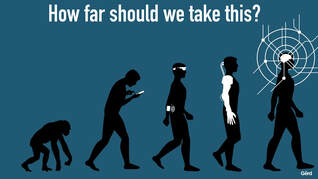 “The dream of the individual that his life could run automatically like an efficient machine, has begun to assume the proportions of a corporate nightmare in which automation unleashes its suffocating powers of standardization, over-regimentation, and depersonalization. Arthur Miller’s trenchant remark that we live in an “air-conditioned nightmare,” implies the unhappy co-existence of technological progress and spiritual regress. Like real nightmares, it takes place within a profound collective sleep therefore offering little chance of discovering either its cause or its cure. Technology can have an anaesthetic effect on man, dulling his moral consciousness and his capacity to enter fundamental, meditative thinking.”
 If you’re getting tired of the drudge of it all, then there is only one option. Opting out and going off grid. That may become a necessity as the new digital currency systems are rolled out, making all transactions trackable and not as anonymous as we are told. Everything will be stored in your digital I.D., and I do mean everything. Social credit systems are coming to the West courtesy of China’s experiment with it, and that is the stated agenda in the World Economic Forum’s “Great Reset”. It is possible to create a parallel economy, and it’s been done before, back before the 20th Century. The nightmarish artwork to the right was created by an A.I. program. It exemplifies everything that John Lash ascribes to Archontic consciousness…chaos is the agenda (link below). Is this what we truly want our lives to be ensconced in?
 Forgiveness is often viewed as the “happily ever after” ending in a story of wrongdoing or injustice. Someone enacts harm, the typical arc goes, but eventually sees the error of their ways and offers a heartfelt apology. “Can you ever forgive me?” Then you, the hurt person, are faced with a choice: Show them mercy — granting yourself peace in the process — or hold a grudge forever. The choice is yours, and it’s one many of us assume starts with remorse and a plea for grace.
 Enright defines forgiveness as a moral virtue. Moral virtues (like kindness, honesty, and patience) are typically focused on how they benefit others; these are things you do primarily for another person’s sake, regardless of whether or not they have “earned” it.
 Enright has studied forgiveness extensively. He says his research group at the University of Wisconsin Madison was the first to publish a scientific study on forgiveness, in 1989; in 1993, they became the first to publish a scientific study of forgiveness therapy. Their research has led to the development of a step-by-step process for forgiveness, which can happen in therapy (ideally with someone who is trained in forgiveness therapy), or through a self-guided process using his workbook.
 Let’s play a game of “would you rather.”
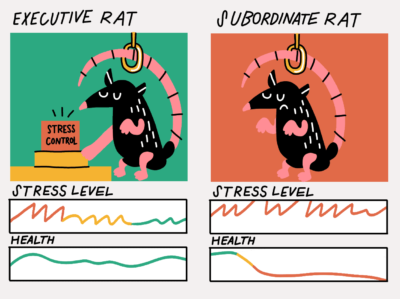 The rat with the lever in its cage is called “the executive rat,” because it has control. It has the power to turn off the electric current flowing through the cage. The rat with no control is called the “subordinate rat.”
 Are you facing the stress of an uncertain future? If so, it helps to focus on what you can control. Sometimes that means bringing the finish line closer by setting goals for today or this week instead of trying to figure out what you’ll do if you lose your job three months from now. Sometimes, it means making a list of 10 ways you can stay connected with friends and choosing the best one to put into action.
 For example, an entrepreneur who feels constantly pressed for time during her nine-hour workday might experiment with doing a 14-hour workday once per week for three weeks. Each of these long workdays is followed by a shortened workday of only six hours. In this case, she is stretching her sense of what’s possible by working longer than what feels comfortable. Then she recovers, taking it easy the next day.