 Spiritual teacher Don Miguel Ruiz brought The Four Agreements into Western awareness. A new thought author versed in ancestral knowledge, Ruiz says the agreements come from Toltec wisdom. The Toltecs were a pre-Hispanic culture living in central Mexico, talented artists and builders as well as warriors.
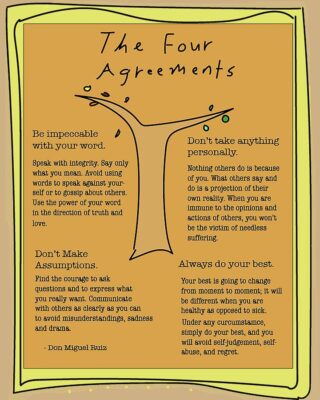
Don Miguel suggests a way of living with these four statements as guidance:
- Be impeccable with your word. I have been addressing this issue for a long time now, mainly because of my own personal experience regarding the power of words. Words are energy, and they have an effect not only in our minds but in our bodies. The energy of words is infused with the feelings that control us at the moment of saying them, and this is when we have to be aware of the vocabulary we are using when talking to others and to ourselves. Be kind. Of course this doesn’t mean that you can’t be strong when the situation requires it. The point here is to be assertive, compassionate, but lovingly firm at the same time.
- Do not take anything personally. As human beings, we have the tendency to take any situation, comment or action in a personal way. This is normal, we value and take into account what others think of us, what others say to us. However, let’s remember that we are unique beings, with our own path and not everyone might understand this. Then, without being condescending, let’s try to elevate ourselves from any harmful scenario created by others and continue to live our lives on our terms. Put everything into perspective and act accordingly.
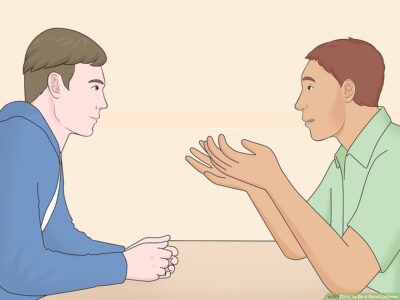
- Do not make assumptions. We are all quick to judge, form ideas in our minds, and because they are there we take them as being true. This agreement invites us to pause before assuming something about a person or a situation, and try to gather more information before forming an opinion. Communication here is key, because is a good way to clarify events and ideas about others. As a solid principle, is much better to have an honest conversation with those involved.
- Always do your best. Life is not easy, however we can make it more pleasant and this involves a conscious effort of trying to do, and I would add, to be, our best. In his book, Ruiz sees this fourth agreement as the final step to incorporate and practice the three previous agreements. By being vigilant with our words, aware of our personal value, communicating well, we automatically will be doing our best.
The Four Agreements are really a code of conduct or behaviour. My experience with these kind of statements is that we read them, we find them inspiring, but then we move on to the next topic of interest. So how can we put the Four Agreements into practice with more ease, and make them relatable to us?
Along the many years of my spiritual path, I have come to realise that when I make these codes mine, I am able to practice them without effort. This is what I do and what I suggest you do:
- Change each statement from a command to first person, grammatically speaking
- Have them written where you can see them easily, for example in your phone and on your desk
- Repeat them aloud and in your mind
- When repeating them, feel their meaning in you as well
- When facing any situation, you will be able to remember them better and put them into action quickly.
To be more clear, the Four Agreements look like the following to me:
- I am impeccable with my word.
- I don’t take anything personally.
- I don’t make assumptions.
- I always do my best.
In this sense, when in the middle of a difficult situation, for example, I might say to myself: Veronica, remember, do not take anything in a personal way, or, I don’t take this personally.
In summary, and as a general rule, I encourage you to find your own unique way of putting the Four Agreements into practice. The approach I propose has worked wonders for me; I invite you to try it.
About the Author:

Veronica Sanchez De Darivas is Chilean-Australian, now living in the UK and a proud mother of teenage twins. A spiritual awakening teacher, bestselling author, pineal gland (third eye) activator and Certified Instructor for the Cyclopea Method, Veronica is currently the only instructor in the world teaching the Cyclopea Method in English.
 Recovering from a happy childhood can take a long time. It’s not often that I’m suspected of having had one. I grew up in Norman, Oklahoma, a daughter of immigrants. When I showed up at college and caught sight of other childhoods, I did pause and think: Why didn’t we grow our own tomatoes? Why did I watch so many episodes of “I Dream of Jeannie”? Who is Hermes? What is lacrosse? Was my childhood a dud? An American self-inspection was set in motion. Having lived for more than forty-five years, I finally understand how happy my childhood was.
 In the run-up to marriage, many couples, particularly those of a more progressive bent, will encounter a problem: What is to be done about the last name?
 In a forthcoming study, Kristin Kelley, a doctoral student working with Powell, presented people with a series of hypothetical couples that had made different choices about their last name, and gauged the subjects’ reactions. She found that a woman’s keeping her last name or choosing to hyphenate changes how others view her relationship. “It increases the likelihood that others will think of the man as less dominant—as weaker in the household,” Powell says. “With any nontraditional name choice, the man’s status went down.” The social stigma a man would experience for changing his own last name at marriage, Powell told me, would likely be even greater.
 That’s what legendary Vietnamese Zen Buddhist monk, teacher, and peace activist Thich Nhat Hanh (October 11, 1926–January 22, 2022) explored in How to Love — a slim, simply worded collection of his immeasurably wise insights on the most complex and most rewarding human potentiality.
 And yet because love is a learned “dynamic interaction,” we form our patterns of understanding — and misunderstanding — early in life, by osmosis and imitation rather than conscious creation. Echoing what Western developmental psychology knows about the role of “positivity resonance” in learning love, Nhat Hanh writes:
 In 2007, a group of researchers began testing a concept that seems, at first blush, as if it would never need testing: whether more happiness is always better than less. The researchers asked college students to rate their feelings on a scale from “unhappy” to “very happy” and compared the results with academic (GPA, missed classes) and social (number of close friends, time spent dating) outcomes. Though the “very happy” participants had the best social lives, they performed worse in school than those who were merely “happy.”
 Life has sped up. A never-ending stream of stimuli is vying for your attention every minute of the day. Some of it is fabulous and some of it is time wasting.
 In a world where it is almost impossible to lose contact with friends, thanks to the likes of social media, this regret may seem irrelevant. You can send someone a text to say you’re thinking of them, comment on their Facebook feed or Instagram photo, or chat via Messenger. But how long is it since you’ve really connected with these people in real life? How long since you’ve laughed together, cried together, eaten together or just hung out?
 The night is going well. Everyone is laughing, and there is a happy energy in the air. The conversation flows easily and you’re the merry, relaxed kind of drunk. Then Josh swaggers over with a tray of something. Then you see what it is. Oh no.
 If you’ve ever tried to make new friends as an adult, you’ll probably see why loneliness is at an all-time high. Making new friends feels just plain hard.
 This won’t be news to many of us. When we have demanding work schedules, very involved family lives or a combination of the two, our time for investing in friendships drops. Even when we meet a promising new friend, it can be hard to carve out time to invest in it. This is a bigger problem for older adults, given most people find their obligations increase with age.
 Yes, I know there are many realities, but let’s just for a moment distinguish them as two … normal reality and NEW reality.
 Some people are incredibly likable because of the things they do. Some people are incredibly charismatic because of the things they do.