

 We all want to feel inner peace. We look for it throughout our entire lives, as being at peace allows us to dream and to actually follow those dreams. When we are at peace with ourselves, we are more understanding and loving towards others, we are able to embody the concept of being One, and therefore we create deeper and more meaningful connections with family, friends and people in general.
Confidence is very important, too. When we have confidence in our inner self, we are more prepared to take risks to advance, and we feel focused and motivated to face challenges. Confidence is believing in our own abilities and skills to do what we want and need to do in order to achieve a good quality of life, not only in the physical world, but also in the spiritual realms of existence.
I want to share a few ways of creating inner peace and confidence in this new year. Just by committing to one of these suggestions, you will see transformation happening in your soul and body.
- Change habits
We are all attached to habits that in the long run do not allow us to advance in our inner self journey. In this sense, observing one self in order to identify a few of those habits is advisable. A good way to do this is to sit down in silence and review your daily habits one by one, being very honest with yourself.
Once you have identified those habits you want to change or completely delete from your life, start with the process of substitution. Go little by little and be realistic, which means doing what you are prepare to do, without overwhelming yourself, because implementing new habits should be easy. If you are going to get stressed trying to make a lasting change, not doing it at all is better. Your emotional and mental health come first.
“If we could change ourselves, the tendencies in the world would also change.” ~ Ghandi
- Start a daily meditation practice
 Meditation has been found to have numerous scientific benefits. For example, it reduces stress, improves concentration, boosts creativity, and increases happiness. Meditation affects our mental health in a positive manner, decreasing anxiety and depression, improving sleep, and enhancing self-awareness
The benefits of meditation touch our physical being as well. Research shows that it helps lower blood pressure, thereby improving cardiovascular health and strengthening our immune system.
There are numerous types of meditation. However, when starting it is better to follow guided meditations, as this kind of meditation allows us to understand what we are really doing and to enter into the practice with ease. And don’t overwhelm yourself! Set an achievable time, like 5 to 10 minutes per day, to start. Once you have learned to meditate for this length of time comfortably, you can increase it.
“The energy of the mind is the essence of life.” ~ Aristotle
- Cultivate a positive attitude
A positive attitude has been linked with increased happiness, health and success in all areas, including the spiritual realm. Make an effort to be more positive this year. This does not mean you should avoid negative thoughts and feelings. Instead, acknowledge them and aim to elevate yourself by seeing them in another light. Find solutions from there.
“The happiness of your life depends upon the quality of your thoughts.” ~ Marcus Aurelius
- Practice living in the now
Making a conscious effort to focus on the present involves attention. We have to control our attention, observe where we are placing it and bring it to the now. It is normal to think about the past or the future, but remember that the past is gone and the future never really arrives, we always live it in the present. Sense, live and enjoy every moment of your day. Try this approach and see what happens.
“The present moment is filled with joy and happiness. If you are attentive, you will see it.” ~ Thich Nhat Hanh
- Practice gratitude
Gratitude is a powerful feeling, because, for me, it is love in action. Make it a habit to focus on the things you are grateful for, big and small. You could start a gratitude journal, which I am doing this year. I have created my own journal and my aim is to write in it every day. You can also take a few moments each day to reflect on the things you are grateful for.
Science has proven that feeling and expressing gratitude impacts our emotional and mental health in a positive way. In fact, the HeartMath Institute has discovered that, “Gratitude releases a powerful, self-rewarding feel-good neurotransmitter in the brain.” Furthermore, they have measured the heart rhythms of people when they feel gratitude and appreciation, and the results show a coherent rhythm: in other words a coherent heart.
“Gratitude is not only the greatest of virtues, but the parent of all others.” ~ Marcus Tullius Cicero
- Get organized
While this advice might not seem to be “spiritual”, nourishing our inner self requires discipline, will and order. Organisation in certain areas of our lives brings us joy and a sense of freedom.
This same idea should be applied to our spiritual practices, meaning that it is important to create a routine and ways of tackling such practices. For example, every morning I start my day with a short meditation and connection to the Source exercise, then I say a few decrees and I end with a short positive visualisation of the activities of the day.
Our external life needs organisation, too. One of the things I do the first month of the year is reorganise my closet, and any place at home in need of order. By doing so, I am creating space not only in my physical surroundings, but in my mind and in my heart. I encourage you to get rid of anything that bothers you and is only collecting dust. Organisation is liberation!
“Organization is what makes the impossible possible, the easy easy, and the difficult manageable.” ~ Zig Ziglar
About the Author:

Veronica Sanchez De Darivas is Chilean-Australian, now living in the UK and a proud mother of teenage twins. A spiritual awakening teacher, bestselling author, pineal gland (third eye) activator and Certified Instructor for the Cyclopea Method, Veronica is currently the only instructor in the world teaching the Cyclopea Method in English.
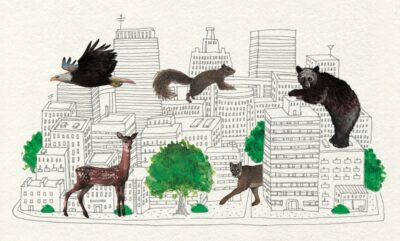
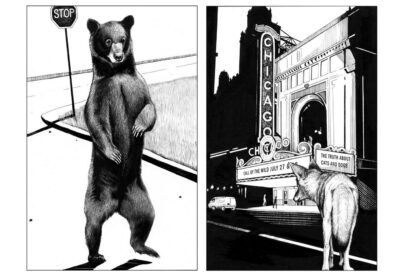 These domesticated animals then get cleared out by the late 19th and early 20th centuries, leading to this period from about 1920 to 1950 where there are fewer wild animals living in urban areas, particularly in North America, than really at any time before or since. This is a period in which some of the greatest thinkers about urban life were doing their writing, and almost everybody assumed that cities weren’t going to have animals in them.
 But these examples are exceptions, not the rule. And this is very time-dependent: Although there are a small number of creatures that can adapt very quickly, for most others, this would take a long period of time — much longer than it takes for their populations to go extinct. And so the problem is [talking] about this as a solution to the fact that we’re rearranging and degrading ecosystems in ways that make the world a much harder place to live for the vast majority of species out there.
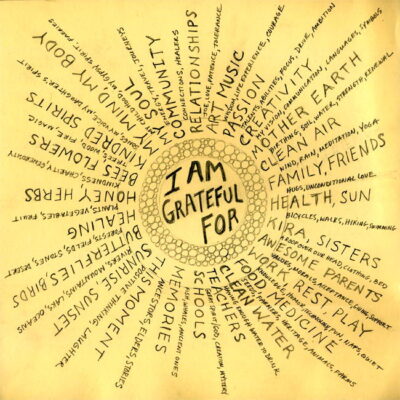 In Sidetracked: Why Our Decisions Get Derailed, and How We Can Stick to the Plan, Francesca Gino, an associate professor at Harvard Business School, explores a range of fascinating subjects, including how emotions influence decisions and the often-thorny matter of understanding the perspectives of others. Blending social science and real-world examples, Gino’s book also highlights the science of gratitude.
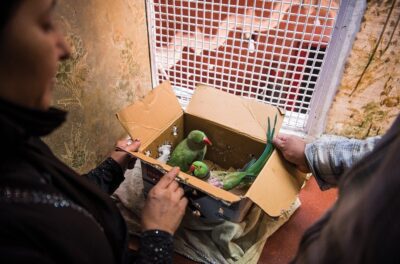
 Amid the human crush of Old Delhi, on the edge of a medieval bazaar, a red structure with cages on its roof rises three stories above the labyrinth of neon-lit stalls and narrow alleyways, its top floor emblazoned with two words: birds hospital.
 I’d come to the bird hospital, and to India, to see firsthand the Jains’ moral system at work in the world. Jains make up less than 1 percent of India’s population. Despite millennia spent criticizing the Hindu majority, the Jains have sometimes gained the ear of power. During the 13th century, they converted a Hindu king, and persuaded him to enact the subcontinent’s first animal-welfare laws. There is evidence that the Jains influenced the Buddha himself. And when Gandhi developed his most radical ideas about nonviolence, a Jain friend played philosophical muse.
 In the West, consciousness was long thought to be a divine gift bestowed solely on humans. Western philosophers historically conceived of nonhuman animals as unfeeling automatons. Even after Darwin demonstrated our kinship with animals, many scientists believed that the evolution of consciousness was a recent event. They thought the first mind sparked awake sometime after we split from chimps and bonobos. In his 1976 book, The Origin of Consciousness in the Breakdown of the Bicameral Mind, Julian Jaynes argued that it was later still. He said the development of language led us, like Virgil, into the deep cognitive states capable of constructing experiential worlds.
 Crows are not among the shoulder-perchers, but Singh sometimes sees former crow patients hovering around the hospital. They might be looking for him. Crows recognize individual human faces. They are known to blare vicious caws at people they dislike, but for favored humans, they sometimes leave gifts—buttons or shiny bits of glass—where the person will be sure to notice, like votive offerings.
 The trail was only 50 miles from Gir National Park, where, the day before, I’d seen two Asiatic lions, nearly indistinguishable cousins of Africa’s lions. Once the region’s apex predator, the Asiatic lion almost went extinct during the British empire’s colonization of India, when no viceroy could visit a maharaja’s palace without a hunt in the local forest. Even today, the Asiatic lion still ranks among the rarest of the large feline predators, rarer even than its neighbor to the north, the snow leopard, which is so scarce that a glimpse of one padding down a jagged Himalayan crag is said to consummate a spiritual pilgrimage.
 The monk was a white dot some six switchbacks up by the time I hopped off the wall and continued the climb, my legs stiffened by the break. I reached the entrance to the temple complex with only 15 minutes to spare. Its marble courtyard shone brilliant white, as though bleached by the mountain sun.
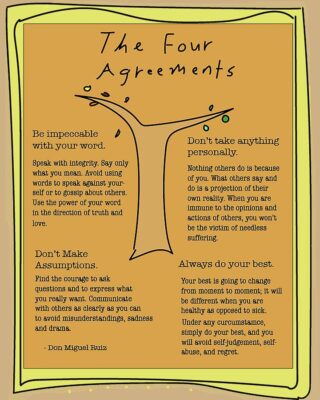 Spiritual teacher Don Miguel Ruiz brought The Four Agreements into Western awareness. A new thought author versed in ancestral knowledge, Ruiz says the agreements come from Toltec wisdom. The Toltecs were a pre-Hispanic culture living in central Mexico, talented artists and builders as well as warriors.
 That’s what legendary Vietnamese Zen Buddhist monk, teacher, and peace activist Thich Nhat Hanh (October 11, 1926–January 22, 2022) explored in How to Love — a slim, simply worded collection of his immeasurably wise insights on the most complex and most rewarding human potentiality.
 And yet because love is a learned “dynamic interaction,” we form our patterns of understanding — and misunderstanding — early in life, by osmosis and imitation rather than conscious creation. Echoing what Western developmental psychology knows about the role of “positivity resonance” in learning love, Nhat Hanh writes:
 I believe in angels. I feel their presence in my life every hour, minute and second, I know they are with me, with us, but how? From a rational point of view, it is probably impossible to explain their existence, however I can say that they are part of my experience.