
Imagine all the people living life in peace. You may say that I’m a dreamer, but I’m not the only one. I hope someday you’ll join us and the world will be as one.“
~ John Lennon
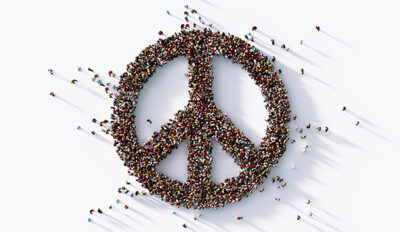
Our planet is experiencing hard times. Before, it was and still is the pandemic; now it is war. Peace seems to be only a nice word, and sometimes a futile desire. How do we bring peace to the world?
There is no doubt in my heart and mind that the first step to manifest peace is to become a being of peace. Being peace means to be able to act in our daily life from an elevated vibration or frequency, it means to approach any hard situation with calmness and love.
We have all experienced traumatic events in our lives, and somehow most of us are able to overcome those hard situations one way or another. Why?
Because in the middle of the emotional storm we might have been experiencing, we have managed to slip into a peaceful mode, where we allowed ourselves to think and see a path of action. This might last only a few seconds, however the repercussions can be felt longer. To be at peace is to be still, stopping all activities and the busyness of our minds.
According to the Cambridge Dictionary, peace is “freedom from war and violence, especially when people live and work together happily without disagreements,” and this is more or less the definition we find in most dictionaries. We can see that for many people, peace is the opposite of violence, but for me peace is a state of being and acting in the world.
Peace is feeling the silence between the noise, the pause between words, the “nada” between the beating of our heart. Peace is awareness, is consciousness.
When we realise that peace is always possible and a choice, it is very hard to ignore it. Imagine what the world would be if everyone was able to feel peaceful, because, in reality, peace is a feeling, a thought-form capable of expanding from one person to another, then it is wise to start practising low motion, stopping and acknowledging the inner calmness that comes with us.
Here is one exercise you can start doing now:
- Sit down and relax your body
- Start breathing in and out a bit slower than normal
- Place a hand on your heart and feel its palpitation
- Pay special attention to the moment your heart stops for a millisecond before the next beat.
- If it is difficult for you to feel your heart, focus on your breathing, paying attention to the moment you stop before inhaling and exhaling
- Do this for a few minutes and feel a sweet sensation invading you. That sensation is peace.
And I am also adding a decree for you to repeat as many times as you want: Peace in me, peace around me, peace in the world.
Being peace, in my understanding, makes peace on our precious planet possible.
About the Author:
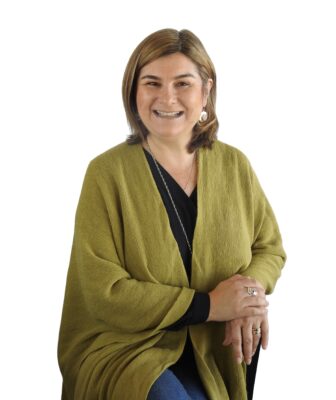
Veronica Sanchez De Darivas is Chilean-Australian, now living in the UK and a proud mother of teenage twins. A spiritual awakening teacher, bestselling author, pineal gland (third eye) activator and Certified Instructor for the Cyclopea Method, Veronica is currently the only instructor in the world teaching the Cyclopea Method in English.
 “People think of laws being so objective and serious, and almost separate from the social norms,” says investigative climate journalist Amy Westervelt. “But it’s really just a handful of people’s beliefs that have gotten baked into law.”
 And it might just be working. She says the proof is in the pushback.
 With tonight’s Mercury station direct, we have another equally substantial event: the Sun is conjunct Saturn at the midpoint of Aquarius. This is a combination of aspects that says: Slow Down and Pay Attention. Many more celestial events argue for the same approach.
 These involve two things that are really one: social patterns, and the imposition of technology upon us. Aquarius is about electricity, and we now live in an entirely electrical society. We also live in a digital society. The patterns of our lives are now all but dictated by cellular technology. The “net” or the “web” now encompasses everything.
 Active people tend to overthink what food is doing for their body — Is keto good for endurance? What’s the perfect post-training macro spread? Butter or no butter in my coffee? — but underthink what it’s doing for their mind. Yet you’ve probably noticed that what you eat impacts what’s going on upstairs. We’ve all devoured a cheat meal and afterward felt off, not just physically but also mentally and emotionally. And new research suggests that the connection between diet and mental well-being is a little more nuanced than scientists once thought.
 In the U.S., millions of shoppers pack clothing stores, excited to key into the newest trends while paying low prices. On the other side of the world, low-wage workers—many of them young girls— are crushed under the hammer of “fast fashion” (the mass production of cheap, poor quality, disposable clothing), laboring without safety protections or adequate rights. Fast fashion’s impacts on both the environment and human rights are evident, and slow fashion may just be the only solution to a greener future.
 Many meditators, healers and people of goodwill are attracted to the idea of distant healing — that in meditation, contemplation and prayer we can help relieve suffering and pain at a distance.
 We may be slowly returning to our offices (more or less), but the strains of the pandemic are hardly over. As we enter a transitional stage after almost two years of trauma and strain, more than ever we need ways to refresh our energies, calm our anxieties, and nurse our well-being. One potentially powerful intervention is rarely talked about in the workplace: The cultivation of experiences of awe. Like gratitude and curiosity, awe can leave us feeling inspired and energized. It’s another tool in your toolkit and it’s now attracting increased attention due to more rigorous research.
 About 20 years ago, working for National Geographic, and with a grant from the National Institute on Aging, I started identifying and studying the longest-lived people, those who are in what we called the world’s Blue Zones. These are people who have eluded heart disease, diabetes, dementia, and several types of cancer.
 Have you ever gotten into bed at the end of the day and realised that you haven’t spoken out loud to anyone since the day before? Or simply found yourself feeling completely and utterly alone?
 “Those who are emotionally lonely will find it difficult to improve things without tackling the root of the problem,” says Dr. Spelman. “Emotional loneliness is not circumstantial but, rather, comes from within.”
 But situational loneliness doesn’t just arise in those who relocate alone, as social media editor Sarah discovered when she moved countries with her partner. Sarah left her Sydney home in March 2017 to join her partner in London, where he had arrived a month earlier to start a new job and find the pair a home to live in — although she admits that “didn’t mean it was smooth sailing”.
 “It was a really bewildering, lonely time,” she says. “The jump of being plonked into a huge arts school, in just one of hundreds of halls of residence in a sprawling city I didn’t understand, made me retreat into myself and I struggled to make friends in the face of it all.