 I bike the same route to my job every morning. Turn right, over a bridge, gentle left, hard left, hard right, check for cars at the 4-way stop, left turn, gentle right, huff and puff up the same long hill… and on I go. I can recite the entire route from memory. Same streets, same houses, same trees, same lake, same parks, all whizzing by as I focus on the road ahead, keeping up my speed to get a good workout and get to work on time.
I vary the return trip a bit at the end of the day because I have more time to explore. But do I get bored with the morning ride? Never! A few days ago, for example, those “same” streets were very much not the same, because it was still dark out, rain was smearing my glasses, and the road was covered in bright yellow, wet autumn leaves. I felt deep gratitude for the “beginner’s mind” that steered carefully and kept my speed under control through those slippery crash hazards. In the moment, I appreciated my bike, my legs, and my bright headlight. It all made me smile, to be awake and aware, and the sun was rising when I pulled into my destination.
Often we think we need something new and different in order to be happy; we think we can only be stimulated by change. Maybe you have walked the path 1,000 times between your home and your car, or the bus stop, or wherever you keep your bicycle. So you think you’ve done it, seen it, nothing is new. You may sigh and say “Been there, done that” and feel unhappy.
But in reality, we’ve never experienced this moment before. Not this one either. Nor this one.
In the eyes of a beginner, our path has many wondrous things to notice, smile at, even celebrate. Because with every moment things are changing. What are you looking at? Are you stopping to look with fresh eyes?
Joanne Friday writes beautifully about this in her story “Freedom from My Own Mind,” in the book Tears Become Rain: Stories of Transformation and Healing Inspired by Thich Nhat Hanh. When a brain injury after a car accident left her with no memory and the inability to manage her stress hormones, she writes, “I was trapped in a constant state of anxiety and fear.” Spontaneously joining a retreat with the Zen master Thich Nhat Hanh, Joanne learned the joy of looking with fresh eyes at what was right in front of her. “Since I had no memory of the past and was in fear of going forward in my life with no ability to think or function well, I loved the idea of focusing fully on the present moment.”
This new way of seeing the world also applied to how Joanne viewed her own injured body. Daily walks prescribed by her doctor were torment, as she focused on the pain from her ruptured discs and her mind filled with fear and speculation that she couldn’t return to the healthy self she once knew. But then Joanne tried walking meditation, taking slow steps outdoors and focusing on the miracle of being a part of everything. “The trees exhaled what we inhaled, and we exhaled what the trees inhaled. When we focus on what a miracle this precious lifetime is, we are walking in the kingdom of heaven,” she writes. “I realized that where I chose to place my mind determined my experience. I had a choice!”
 I was asked recently how we can find happiness in this world that contains so much conflict and suffering. I find happiness because I look for it, right where I am, just like Joanne did. There are tiny flowers on the ground and funny bumper stickers on people’s cars. The person who walks past me has a face, and it might smile if I smile at them. When I look as a beginner looks — as if I haven’t already seen a million flowers, read all the bumper stickers, passed so many faces in my lifetime — I experience these little joys.
My wife still makes me laugh, after 22 years. Yes, we’ve struggled, and we still have our struggles, but because of that we also notice and cherish our happy moments. We’ve never been here before, with all that brought us to this point, with all the challenges swirling in our brains, with whatever is going on in our work lives, our community, and the world. We truly have never been here before. And in this moment at the dinner table, I see her make a silly face, hear her bad pun or her intentionally obtuse question that makes our kids and me stop and wonder if she’s all there.
I could think with exasperation, “Oh there she goes again being silly.” Or look at her and roll my eyes, as our teenage kids sometimes do. But instead I get to laugh at her lightness, as if this is the first time, because it is! What a wonderful feeling when we pause and look in each other’s eyes, and catch the eyes of our kids, and know we are enjoying this moment together.
And that lightness then spreads. Laughter is like yoga, making happy chemicals move around in our brains. Our teenagers may even admit that smiling feels way better than eye rolling. They see my glee at their other mom’s silliness, and it’s contagious. Finding joy isn’t a crime, even when others around us are suffering. I see it as the opposite: Our happiness waters our seeds of compassion because we know that others want happiness too. Instead of getting lost in our own dissatisfaction at the “same old same old,” we can look and see those around us who need our smiling face, open to the possibility of this new moment.
Original article here
 If Socrates was the wisest person in Ancient Greece, then large language models must be the most foolish systems in the modern world.
 And bullshit is dangerous, warned Frankfurt. Bullshit is a greater threat to the truth than lies. The person who lies thinks she knows what the truth is, and is therefore concerned with the truth. She can be challenged and held accountable; her agenda can be inferred. The truth-teller and the liar play on opposite sides of the same game, as Frankfurt puts it. The bullshitter pays no attention to the game. Truth doesn’t even get confronted; it gets ignored; it becomes irrelevant.
 I believe this with every fibre of my being and I live it, in myself and witnessing it in others, in every way I can. So what are some of these super powers that we’re seeing these days? I’ll try to encapsulate a few of the ones I’m aware of.

 Every once in a while I wonder how my life can get any better. And then it does! Over and over again. How is it that that can happen without much effort on my part to make it so? Here are my #lovinglife suggestions for joy seekers everywhere.
 I have come far in my life, farther than I ever dreamed was even possible. And yet my dreaming continues, urging me ever onward.


 The good life is the simple life. Among philosophical ideas about how we should live, this one is a hardy perennial; from Socrates to Thoreau, from the Buddha to Wendell Berry, thinkers have been peddling it for more than two millennia. And it still has plenty of adherents. Magazines such as Real Simple call out to us from the supermarket checkout; Oprah Winfrey regularly interviews fans of simple living such as Jack Kornfield, a teacher of Buddhist mindfulness; the Slow Movement, which advocates a return to pre-industrial basics, attracts followers across continents.
 Somewhat paradoxically, then, the case for living simply was most persuasive when most people had little choice but to live that way. The traditional arguments for simple living in effect rationalise a necessity. But the same arguments have less purchase when the life of frugal simplicity is a choice, one way of living among many. Then the philosophy of frugality becomes a hard sell.
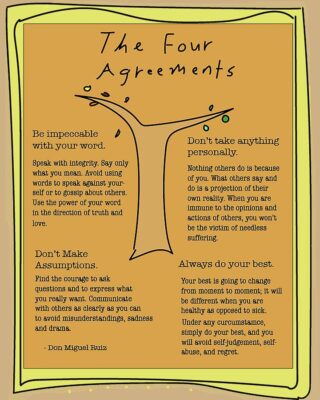 Spiritual teacher Don Miguel Ruiz brought The Four Agreements into Western awareness. A new thought author versed in ancestral knowledge, Ruiz says the agreements come from Toltec wisdom. The Toltecs were a pre-Hispanic culture living in central Mexico, talented artists and builders as well as warriors.