We are spiritual beings having a physical experience. The purpose of incarnating is simply to give us the unique experiences we need for our progressive evolution toward perfection. Within each of our Earthly experiences, there are important lessons we’ve chosen to learn. On a subconscious level, we are attracting the people and experiences that will teach us these lessons.
You can heighten your awareness to help you recognize and embrace the synchronistic opportunities that are always presenting themselves in the form of people, places and events around you. First of all, commit to engaging in the reality that surrounds you, which might also mean turning off devices. You must also make an effort to disengage from the flurry of thoughts swirling through your head that distract you from fully appreciating your surroundings. A powerful practice I use is to say out loud or in my head, “Moment!” This immediately draws my attention back into the present, and I can more effectively engage with the world around me.
A scientific concept that reinforces the importance of our engagement with others is the quantum theory of entanglement. This theory states that whenever we exchange energy with another living being, that energetic connection will remain intact for all time. This means that every interaction you have with another living being will remain forever imprinted on both of you.
With this in mind, ask yourself: “What type of karmic imprint do I want to leave on myself and others throughout the day?” and “How can I improve the quality of the energetic connections I am making?”
Consider that our paths are predestined. We have come here on Earth to learn the life lessons that will allow us to progress on our paths. As such, we naturally create the experiences that are most likely to help us learn and grow. We attract the people, places and things that are most conducive to our soul’s evolution. Spiritual guides may also place certain people in our path to assist us on our journey. The key to recognizing these people and places as opportunities to learn and grow is to continually search for the deeper meaning of our interactions with them.
We have to ask ourselves questions like, “Why have I been placed in this particular location at this particular time, and how is this situation conducive to my growth?” We also have to explore relationships on a deeper level by asking ourselves, “Why have I been connected with this person and how can we benefit each other?” and “What lessons can we learn from each other?” By making a sincere effort to uncover the meaning behind our everyday experiences and interactions, we can reveal their higher purpose and learn to go with the flow.
Here are three powerful ways to remain open to the synchronistic flow of life’s stream:
- Use the practice of saying, “Moment!” whenever you notice that you have become disconnected from the present moment.
- Be aware of the karmic imprint you are leaving on yourself and others with every reaction and interaction.
- Recognize the people, places and things you have attracted into your life all represent opportunities to learn the lessons that are most conducive to your evolutionary path.
After I began to recognize the divinity within the experiences of my life, I developed a strong faith that everything happens just as it should and for a good reason. Trusting in the divine plan has made me feel much more at peace with the events that unfold around me. I know I have projected these experiences in order to learn the lessons I need for my soul’s evolution and refinement.
Now that I am more capable of taming my mind and controlling the emotions of fear, anger and resentment, I am not experiencing those emotions reflected back to me. As a result, I naturally create more harmony and encounter less difficulty. This perspective has made my life so much smoother and more enjoyable. I’ve also become acutely aware that as I project compassion and kindness, these divine traits are reflected back to me.
This is true across the board and rarely does it fail me. When it does, I am able to see the symbolic nature of the experience and then identify my own personal emotions that, left unguarded, created conflict. Negative feelings, or trapped emotions, that still need my attention and repair are exposed. From this perspective, I am then grateful for the conflict because it revealed lessons I still need to learn. I can commit to learning those important life lessons right then and there, and avoid re-creating another experience just like it!
It’s really that easy. By opening yourself up to the world around you in this way, you are opening to spirit. Aligned with spirit, magical synchronicities will unfold as you meet opportunity at every intersection. The power is in the present moment.
Original article here


 Malidoma is from a collectivist society. Born into the Dagara tribe in Burkina Faso, he is the grandson of a renowned healer, who travels around the world but is based in the U.S. Malidoma sees himself as a bridge between his culture and the United States, existing to “bring the wisdom of our people to this part of the world.” Malidoma’s “career”—he chuckles at the term—is some combination of cultural ambassador, homeopath, and sage. He travels the country doing rituals and consultations, writing books, and giving speeches. He has three master’s degrees and two doctorates from Brandeis University. Sometimes he calls himself a “shaman,” because people know what that means (sort of) and it’s similar to his title back in Burkina Faso—a titiyulo, one who “constantly inquires with other dimensions.”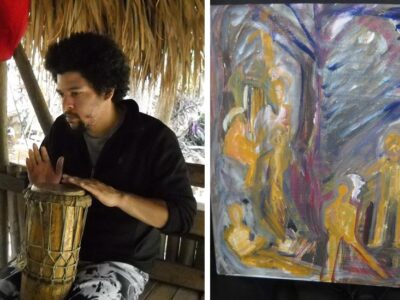





 What rules are meaningful and valuable; which ones perpetuate inequality? At what point do we substitute deference to authority with our own autonomous consideration—and what might emerge if we were to choose our own distinct path? To hone our capacity for independent judgment, political scientist James Scott urges a daily practice of “anarchist calisthenics,” a form of small-scale rebellious action that cuts against the grain of authority; he envisions minor acts of law-breaking, in cases where this would not endanger others or undermine social well-being. Hierarchies that bring with them pogroms and violence, oppression and exploitation, are not easily overturned: such recognition of the stability of unjust systems requires him to “confront the paradox of the contribution of law-breaking and disruption to democratic political change”; law-breaking is needed to break the stranglehold of unjust rule. In Scott’s assessment, “Most of the great political reforms of the nineteenth and twentieth centuries”—among which he describes those for racial equality and civil rights—“have been accompanied by massive episodes of civil disobedience, riot, law-breaking, the disruption of public order, and, at the limit, civil war.” But, in societies defined by hierarchy, how do we develop the skills for anything else? Scott advises carefully chosen confrontations with imposed laws to assert and practise independence and autonomy without inflicting harm upon others.
 Mostly, the work of non-human entities—animal, plant, fungus, mineral, element—remains illegible to us. This is not for lack of effort: ecologists and physiologists and statisticians map territories and count offspring and track mates, overlay mealtimes and prey densities, measure brain activity and body fat and stomach enzymes. The result is ordered groups and categories of activity, confidently enumerated and named and labelled in terms of productivity. Least flycatchers engaged in aerial acrobatics to snag insects on the wing is sustenance, from this perspective, not entertainment. Wilson’s warblers hopping in the shrub birch branches, munching on little green inchworms, are engaged in functional foraging and not gustatory pleasure. The spruce grouse my black lab flushes from the woods is fleeing for survival, not searching for solitude and hermetic peace. But are we really seeing these lives in their entirety? The porcupine trundling along the trail; the lynx with its unhurried paces along the road; the moose, when not browsing willow, not surveying for wolves, just standing in the brush looking out at the mountains?
 World Journey stories teach us to overcome adversity, but more importantly, they teach us how to experience adversity in the first place. Successful myths, religious texts, and fairy tales — and modern screenplay and film — do not skirt the issue of hardship and conflict, nor do they encourage us to finish the hard work as quickly as possible. The characters in J.K. Rowling’s Harry Potter do not face obstacles and beasts simply to advance the plot, but to develop the inner courage and tenacity needed to grow as individuals within society. Mythic stories put us squarely in the middle of the hardest tasks we can imagine, and they force us to work hard, to guess, to take leaps of faith, and to test ourselves to the limit.