
 If you’re anything like me, the think-pieces you’ve read on how to spot red flags or deal with a friend’s trauma dumping will have become imprinted on your brain. However, it’s also true that sometimes we need to look at the relationship we have with ourselves before analysing the relationships we have with others.
“Being in a toxic relationship comes from the belief you hold about yourself; you deserve love and respect from yourself,” writes psychologist Dr Lalitaa Suglani in an Instagram post on the subject. “It can go beyond just engaging in constant negative self-talk. It can also mean you ignore your health and personal wellness and blame yourself for everything.”
You frequently talk down to yourself and criticise things you do
Negative self-talk is something a lot of people struggle with, and your inner critic can feel incredibly difficult to silence.
“If you find yourself saying something to yourself you wouldn’t say to a friend or even a stranger, that’s something to be aware of,” suggests Dr Suglani. “You have to catch yourself because it starts to feel so normal you don’t even realise you’re doing it.”
You ignore your own boundaries
If the rise of therapy-speak has taught us anything, it’s the importance of boundaries. Without boundaries, we can feel depleted, taken advantage of, taken for granted or intruded upon.
But if we’re not respecting our own limitations, how can we expect others to do the same?
Whether it’s prioritising rest, allowing yourself to say no or tapping in to your internal monologue to figure out how you really feel, it’s crucial to maintain mental wellbeing.
 You struggle with self-care and putting your needs first
Let’s be real: self-care is never as easy as Instagram makes it look. Baths, face masks and candles all have their place, but rarely have a lasting impact.
Instead of relying on sporadic gestures, you could try ‘everyday mental maintenance’ – a technique that takes a proactive, bite-sized approach to looking after your mental health.
It involves setting aside dedicated time to look after yourself, whether it’s a few hours on a Sunday evening to prep meals or a regular exercise class that makes you feel buoyant once you’ve completed it. Taking a few moments to focus on what makes you feel calm, centred and ready to tackle what lies ahead is always a good use of time.
You engage in unhealthy coping strategies
Nobody’s perfect, and we all have less-than-desirable traits and behaviours that we’d rather not see the light of day, even if they do slip out from time to time.
But we owe it to ourselves to do what’s best for both our minds and bodies, in whatever way we can. Holding yourself accountable and committing to a positive action or change is key.
However, if you’re concerned about the way you respond to stress or trauma, it’s advisable to seek professional advice and help from a therapist, counsellor or doctor.
You thrive on drama and chaos
Living life to the wire, with no plan, direction or headspace might feel exciting and vibrant, but there’s something to be said for choosing peace, calm and tranquillity.
You don’t have to give up beloved nights out or start practising daily meditation, but a huge part of protecting your energy and maintaining your boundaries involves stepping away from anything that drains you.
Instead, learn to prioritise the things, people and situations that give you energy rather than take it away from you.
You can be really hard on yourself and feel like nothing you do is good enough
There’s a reason why imposter syndrome has become a mental health buzzword over the past few years. More of us are suffering from it than ever, and it can easily lead us into a spiral of negative thoughts and self-punishment.
If you feel disconnected from yourself, or emotionally burnt out, who can blame you? There’s so much going on in the world that is difficult and painful for us to process.
Overcoming these feelings starts with recognition and acceptance. Remind yourself: “I’m not perfect; I’m a human being and I have my own vulnerability,” while leading from a place of self-compassion.
How to change your relationship with yourself
If you’ve identified with any or all of the above, don’t panic. According to Dr Suglani, the steps below can help you to begin to improve your relationship with yourself.
- Don’t dwell too much on the past, even if repairing the relationship will likely involve addressing past events
- View yourself with compassion. Think: “Would I say this to a friend?”
- Start therapy
- Journal your thoughts to start becoming aware of what/how you think
- Practise healthy communication with the people around you
- Hold yourself accountable
- Be patient with yourself
- Hold space for yourself to change. Healing is a journey
Original article here
 Of course, this is ridiculous. You cannot easily force yourself to forget something or someone. In fact, the more you try, the harder it becomes. But you can stop yourself from reliving those memories. This is what lies at the heart of this week’s question. When something bad happens to you — something traumatic, even — how far should we try to move on and how far should we try to unpack our past? I do not have a psychology degree, and I am not a psychotherapist, so I will approach this from a philosophical point of view and ask: How important is our past to our future? Should Kant try to forget Lampe or carry his memory as part of him? Should Dee let go of the past or dig it up and face it down?







 World Journey stories teach us to overcome adversity, but more importantly, they teach us how to experience adversity in the first place. Successful myths, religious texts, and fairy tales — and modern screenplay and film — do not skirt the issue of hardship and conflict, nor do they encourage us to finish the hard work as quickly as possible. The characters in J.K. Rowling’s Harry Potter do not face obstacles and beasts simply to advance the plot, but to develop the inner courage and tenacity needed to grow as individuals within society. Mythic stories put us squarely in the middle of the hardest tasks we can imagine, and they force us to work hard, to guess, to take leaps of faith, and to test ourselves to the limit.
 I am having one of those days where my thoughts are leaning towards anticipating negative scenarios and engaging in the “what if’s” the mind is so compelled to do. And while, at this point, I know enough of the machinations of the mind to not go down those rabbit holes, it still can nag away at me as it was doing on this particular day.


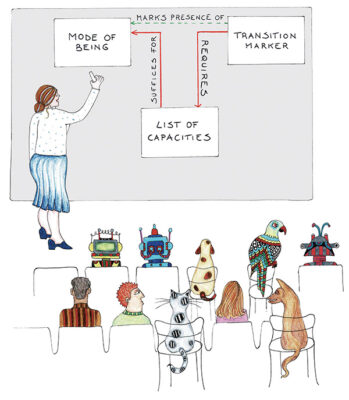 A consensus list of consciousness capacities is a step forward, but identifying each and every capacity may be difficult, and a list does not tell us how they interact to form a conscious being. If we could find a single system-property — an evolutionary marker of consciousness — that indicates that the organism has evolved all the capacities in the consensus list, we would be in a much better position. Finding such a single, diagnostic transition marker would make it possible to identify the simplest evolved conscious being, reconstruct the processes and structures that underlie it, and figure out how they interact. If we can follow the evolution of the marker and therefore the evolution of consciousness, we can discover when and how the conscious mode of being originated.
 The study of associative learning today includes the investigation of the underlying cognitive and neurobiological mechanisms in ecologically relevant conditions such as the social conditions in which animals learn from each other. It is a rich and productive research program, which is no longer constrained by the behaviorists’ maxims. There is an irony in our (qualified) return to the 19th-century suggestion that open-ended associative learning is an evolutionary transition marker of consciousness, the very term that behaviorists tried to purge from psychology.
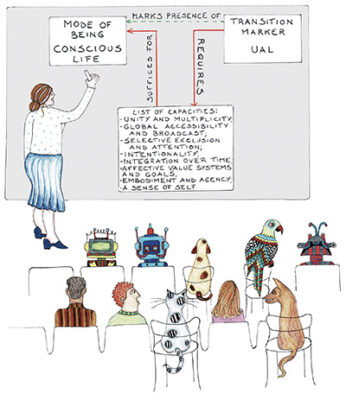 (i) It can distinguish between novel complex patterns of stimuli and actions. For example, it can learn to navigate in a new terrain — to discriminate between different types of animals, between different routes leading to food and shelter. The learned patterns are genuinely novel: they are not reflex-eliciting patterns, nor have they been learned in the past.
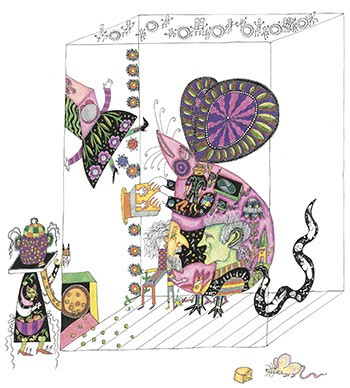
 Animals that could mitigate the high costs of UAL without giving up its benefits would have a great advantage. The evolutionary elaboration of the ubiquitous stress response and the evolution of active forgetting are some of the ameliorating mechanisms that we expect to find in all associatively learning animals, and in particular, in UAL animals. Suffering was not eliminated, but it became more controlled.


 We hate to sound like a broken record, but it really is crucial to incorporate lifting weights into your workout regimen. In fact, when it comes to exercise for older adults, strength training actually trumps cardio because preserving muscle is more important than losing fat as you age.