

Strange as it may seem, early germ theorists could tell us a lot about today’s attitudes toward climate change.
While researching for a new book about the history of emerging infections, I found many similarities between early debates over the existence of microbes and current debates over the existence of global warming.
Both controversies reveal the struggles of perceiving an unseen threat. Both reveal the influence of economic interests that benefit from the status quo. But most importantly, both reveal how people with different beliefs and interests can still agree on key policies and practices for tackling a global problem.
What You Can’t See Might Hurt You
Seeing is believing, and until the mid-19th century, it was very difficult to see the tiny organisms responsible for our so-called “fever” diseases.
Although the indirect evidence was compelling, many people remained skeptical of “animalcules” – as microorganisms were once called – until the microscope was sufficiently developed. Even then, acceptance was gradual. The once-dominant ideas about disease-causing gases, called miasmsas, persisted for several decades before most people acknowledged that the fevers had a living cause.
Climate change presents similar challenges of visibility. Although everyone can see and feel the weather, it is often difficult to observe its larger patterns and longer trends without the aid of technical charts.
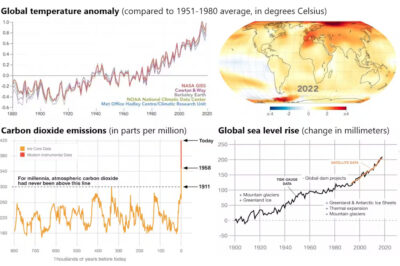
Even when people acknowledge the bigger picture, the case for human responsibility is complicated by the fact that the carbon emissions from our engines, like the germ infections within our bodies, are unseen by the naked eye. It is hard to achieve human solutions when the evidence of human cause is invisible.
Economics Can Outweigh Evidence
Adding to these challenges, economic interests often confound scientific recommendations.
In the case of germ theory, early recommendations to prevent the spread of infection included reinstating quarantines at shipping ports and border crossings, thus impeding the international flow of trade.
In the case of climate theory, recommendations to slow global warming include reducing the consumption of carbon-based fuels, thus reducing the flow of oil. These strategies can threaten livelihoods as well as profits, so it is not surprising to find labor unions divided over green initiatives and energy executives spreading misinformation about climate science.
Beliefs And Interests Need Not Coincide
But people’s beliefs and interests need not align if everyone finds some benefit in the recommendations.
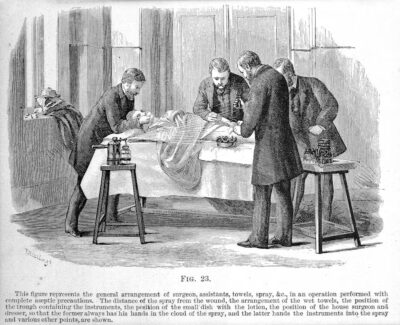
This was the case in the latter decades of the 19th century, when germ-denying surgeons nevertheless adopted the antiseptic techniques of Joseph Lister.
They did so mainly for the practical reason that their patients fared better under the new methods. But if an explanation was needed, many of these die-hard skeptics claimed Lister’s methods prevented the transmission of miasmas rather than living organisms.
Responding to these claims, Lister stated:
If anyone chooses to assume that the septic material is not of the nature of the living organisms, but a so-called chemical ferment destitute of vitality … such a notion, unwarranted though I believe it to be by any scientific evidence, will in a practical point of view be equivalent to a germ theory, since it will inculcate precisely the same methods of antiseptic management.”
Lister was more concerned with saving lives than winning arguments. As long as the surgeons adopted his methods, Lister cared little about their justifications. When it came to preventing infection, it was the behaviors rather than the beliefs that counted.
Changing Behaviors Through Complementary Interests
The same could be said for global warming: Changing behaviors is more important than changing beliefs.
Case in point, there is a large and growing environmentalist movement among evangelical Christians. Organizations such as Green Faith and the Creation Care Task Force cite Biblical scripture to promote environmental stewardship as a sacred duty.
While many of these groups acknowledge human-based climate change, some of their core beliefs contradict the evolutionary theories that my colleagues and I employ as scientists. But we need not agree about fossils to wean the world off fossil fuels.
The same goes for priorities and economic interests.
A recent national Pew survey found that a large majority of Americans support the development and use of renewable energy. This includes a slight majority of Republicans, though their motives tend to differ from those of Democrats.
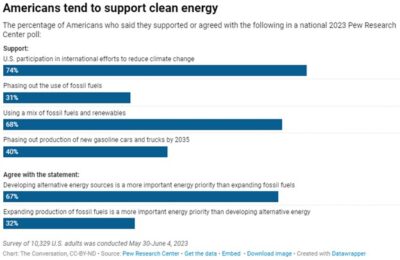
Republicans are more likely to prioritize the economic benefits of renewable energy than Democrats, who tend to list global warming as their driving concern.
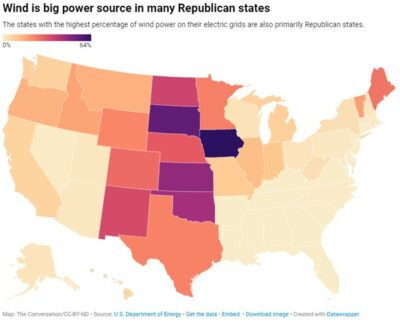
The economic benefits could explain why red states produce the largest share of America’s wind energy and why three of these states are among the nation’s top five producers of solar energy. Their adoption correlates with the geography of the wind and sun belts, where farmers see favorable returns for producing power and a stable source of income to buffer the price fluctuations of weather-sensitive crops. Livelihood is a powerful motivator.
Finding Common Ground Could Change The World
None of these examples address climate change on all its fronts. And among Democrats as well as Republicans, there are different opinions about how fast and how far the transition to renewable energy should go.
But we can take another hopeful lesson from the 19th century: Although people did not agree on all disease-preventing actions, they nevertheless found enough common ground to achieve the greatest mortality decline in recorded history.
Original article here
 If you’re anything like me, the think-pieces you’ve read on how to spot red flags or deal with a friend’s trauma dumping will have become imprinted on your brain. However, it’s also true that sometimes we need to look at the relationship we have with ourselves before analysing the relationships we have with others.
 You struggle with self-care and putting your needs first
 Of course, this is ridiculous. You cannot easily force yourself to forget something or someone. In fact, the more you try, the harder it becomes. But you can stop yourself from reliving those memories. This is what lies at the heart of this week’s question. When something bad happens to you — something traumatic, even — how far should we try to move on and how far should we try to unpack our past? I do not have a psychology degree, and I am not a psychotherapist, so I will approach this from a philosophical point of view and ask: How important is our past to our future? Should Kant try to forget Lampe or carry his memory as part of him? Should Dee let go of the past or dig it up and face it down?




 The late actor Chadwick Boseman found calm in the sound of a djembe drum, said Viola Davis in an interview with USA Today. “One of the things that he carried everywhere was his djembe drum, which is called a talking drum in Africa. And he carried it himself,” Davis remembered about her Ma Rainey’s Black Bottom co-star: “He said ‘Viola, wherever I go, I carry my djembe drum. I do it for me. I play this drum for me, for my healing.’ It felt like he was playing that for God, for himself. There are no words to describe the playing because I love the djembe drum, but listening to him play when he had breaks in that trailer was just phenomenal.”
 World Journey stories teach us to overcome adversity, but more importantly, they teach us how to experience adversity in the first place. Successful myths, religious texts, and fairy tales — and modern screenplay and film — do not skirt the issue of hardship and conflict, nor do they encourage us to finish the hard work as quickly as possible. The characters in J.K. Rowling’s Harry Potter do not face obstacles and beasts simply to advance the plot, but to develop the inner courage and tenacity needed to grow as individuals within society. Mythic stories put us squarely in the middle of the hardest tasks we can imagine, and they force us to work hard, to guess, to take leaps of faith, and to test ourselves to the limit.
 This makes such feelings doubly unwelcome. Most of us can tolerate negative emotions if we see them as instrumental to something desirable—we do not run to a therapist to treat a fear if we think that it holds us back from doing something obviously risky. But unlike fear, what Heidegger calls anxiety and what Heid’s article describes do not protect us from anything specific. No wonder why Sigmund Freud called anxiety a “riddle.”

 I am having one of those days where my thoughts are leaning towards anticipating negative scenarios and engaging in the “what if’s” the mind is so compelled to do. And while, at this point, I know enough of the machinations of the mind to not go down those rabbit holes, it still can nag away at me as it was doing on this particular day.
 Potts stresses that his “mum brought me up good and proper” – but as a teenager growing up in Salford, he started getting into trouble. “We’ve had our hard times with Stuart, but a lot of it was typical boy stuff,” his mum, Pat Malone, said. “We used to say he was a lovable rogue.” Potts went to prison several times in his late teens and 20s, including an 18-month stint for beating up a burglar who had broken into a friend’s house. After he got out, he had a chequered career: working in factories, as a cobbler, locksmith and painter and decorator. But gradually, life stabilised. He got married, moved into a comfortable council house, and had three kids. Then, in 2016, after more than 15 years, the marriage broke down.