
Psychologists have only begun to unravel the concept of “personality,” that all-important but nebulous feature of individual identity. Recent studies suggest that personality traits don’t simply affect your outlook on life, but the way you perceive reality.
One study published earlier this year in the Journal of Research in Personality goes so far as to suggest that openness to experience changes what people see in the world. It makes them more likely to experience certain visual perceptions. In the study, researchers from the University of Melbourne in Australia recruited 123 volunteers and gave them the big five personality test, which measures extroversion, agreeableness, conscientiousness, neuroticism, and openness to experience. That last personality trait involves creativity, imagination, and a willingness to try new things.
They then tested who experienced a visual perception phenomenon called “binocular rivalry.” This phenomenon occurs when each eye is shown a different image—in this case, a red patch in one eye and a green patch to another. Most people switch back and forwards between the two incompatible images, as the brain can only perceive one at a time. But some people merge the two images into a unified red-green patch. Participants who scored higher on openness were more likely to perceive this combined image.
This makes sense, according to the researchers, because openness to new experiences is linked with creativity. In an article on their results in The Conversation, they write that the ability to combine two images seems “like a ‘creative’ solution to the problem presented by the two incompatible stimuli.”
Anna Antinori lead author of the study, explains that we’re constantly filtering out what sensory information to focus on. For example, you might well be subconsciously ignoring the noise around you or the feeling of a chair against your back. And this then determines what we perceive. “The ‘gate’ that lets through the information that reaches consciousness may have a different level of flexibility,” she says. “Open people appear to have a more flexible gate and let through more information than the average person.”
This isn’t the only study that connects personality with perception. As the researchers note in The Conversation, an earlier study shows that those who score high in openness are less likely to experience “inattentional blindness.”
This visual phenomenon occurs when people are focusing so hard on one feature of a scene that they completely fail to notice something entirely obvious—such as in the video below.
Around half of people are so busy watching ball-passes that they miss the man in a gorilla costume.
Though the research suggests that personality affects the way we filter conscious experience, it’s not clear exactly how this process works. The authors speculate that overlapping neurochemicals in the brain may link perception to personality. “Thus the abundance of the same neurochemical, or lack thereof, may affect both one’s personality and low-level vision,” adds Antinori.
There is also evidence to suggest that personality traits aren’t fixed. One study has shown that meditation can affect binocular rivalry, and training can make people more open to new experiences. Then there’s research that shows psilocybin (the key ingredient in magic mushrooms) makes people more open.
But while studies show that personality can shift over time, there’s currently little research on whether perception also changes to correspond with new personality traits. But given the above cited evidence that meditation can shift perception, Antinori believes the way we see the world may well change in line with personality. “It may be possible that a change in people’s personality may also affect how they see the world,” she says.
The mechanics behind how personality is formed—and the effects it has—are still unknown. But mounting evidence suggests that our personalities are affecting our experience of the world in more ways than we realize.
Original article here
 In recent decades, however, Congress has not been good at addressing public concerns when the solutions would displease a powerful and deep-pocketed industry. Governors and state legislators have been much more effective, and their successes might let us evaluate how well various reforms work. But the bottom line is that to change norms, we’re going to need to do most of the work ourselves, in neighborhood groups, schools, and other communities.

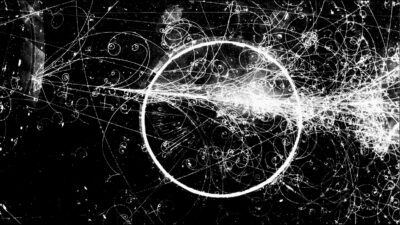
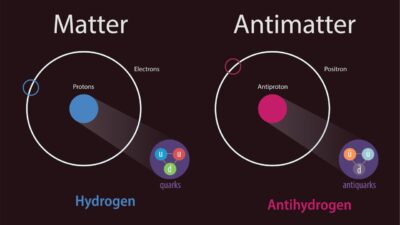
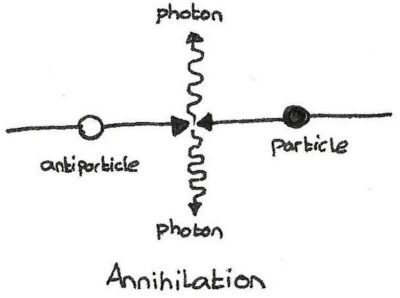 So that’s how the hot Big Bang starts off: with this hot particle-antiparticle soup made up of all allowable species. In the earliest stages, it’s the heaviest particle-antiparticle pairs that disappear first. It takes the most energy to create the most massive particles and antiparticles, so as the Universe cools, it gets progressively less and less likely that the quanta of energy that interact can spontaneously create new particle/antiparticle pairs.
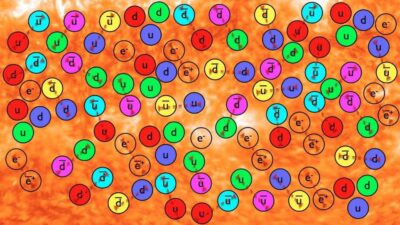 However, since there is somewhere around 1 extra proton (or neutron) for every 1.4 billion proton/antiproton pairs, we’re left over with a small excess of protons and neutrons.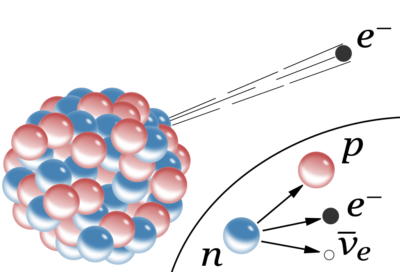
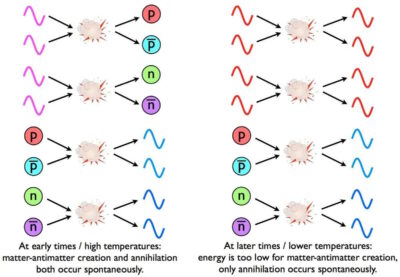
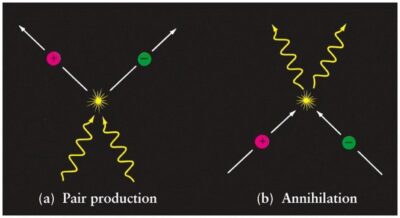 On the other hand, the Universe is still energetic enough that when two photons collide, they can still spontaneously produce electron-positron pairs, and where electron-positron pairs annihilate into two photons. This continues for just a tiny bit longer: until the Universe is about three seconds old (as opposed to the one second freeze out for neutrinos). This “second additional thing,” occurring just slightly after the weak interactions freeze out, means that all the matter-antimatter energy that was tied up in electrons and positrons goes exclusively into photons, and not into species of neutrinos-and-antineutrinos, when they annihilate.
 Microplastics are turning up everywhere, from remote mountain tops to deep ocean trenches. They also are in many animals, including humans.
 By the time you open a container of yogurt, the food has taken a long journey to reach your spoon. You may have some idea of that journey: From cow to processing to packaging to store shelves. But at each step, there is a chance for a little something extra to sneak in, a stowaway of sorts that shouldn’t be there.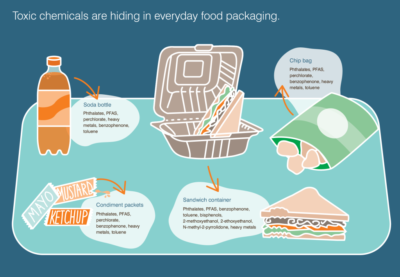
 Time is one of those things that most of us take for granted. We spend our lives portioning it into work-time, family-time and me-time. Rarely do we sit and think about how and why we choreograph our lives through this strange medium. A lot of people only appreciate time when they have an experience that makes them realise how limited it is.
 On 26 February 2015, Cates Holderness, a BuzzFeed community manager, posted a picture of a dress, captioned: ‘There’s a lot of debate on Tumblr about this right now, and we need to settle it.’ The post was accompanied by a poll that racked up millions of votes in a matter of days. About two-thirds of people saw the dress as white and gold. The rest, as blue and black. The comments section was filled with bewildered calls to ‘go check your eyes’ and all-caps accusations of trolling.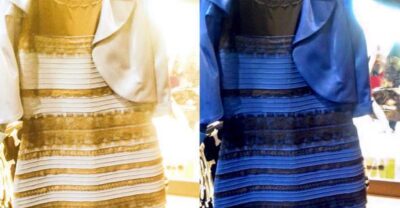
 Lastly, consider dreams. In a 1958 survey, Fernando Tapia and colleagues reported that only about 9 per cent of respondents indicated that their dreams contained colour. Other surveys done around this time reported similarly low proportions. A decade later, the tide turned and a large majority reported dreaming in colour. The philosopher Eric Schwitzgebel considers several explanations for this discrepancy. One possibility is that black-and-white photographs and television changed the content of dreams. As colour TV came to dominate, colour returned to people’s dreams (‘returned’ because, in a few studies from the more distant past, people did not claim to dream in black and white).