
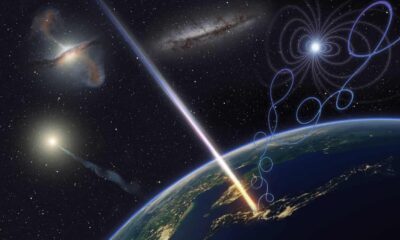
Astronomers have detected a rare and extremely high-energy particle falling to Earth that is causing bafflement because it is coming from an apparently empty region of space.
The particle, named Amaterasu after the sun goddess in Japanese mythology, is one of the highest-energy cosmic rays ever detected.
Only the most powerful cosmic events, on scales far exceeding the explosion of a star, are thought to be capable of producing such energetic particles. But Amaterasu appears to have emerged from the Local Void, an empty area of space bordering the Milky Way galaxy.
“You trace its trajectory to its source and there’s nothing high energy enough to have produced it,” said Prof John Matthews, of the University of Utah and a co-author of the paper in the journal Science that describes the discovery. “That’s the mystery of this – what the heck is going on?”
The Amaterasu particle has an energy exceeding 240 exa-electron volts (EeV), millions of times more than particles produced in the Large Hadron Collider, the most powerful accelerator ever built, and equivalent to the energy of a golf ball travelling at 95mph. It comes only second to the Oh-My-God particle, another ultra-high-energy cosmic ray that came in at 320 EeV, detected in 1991.
“Things that people think of as energetic, like supernova, are nowhere near energetic enough for this,” said Matthews. “You need huge amounts of energy, really high magnetic fields, to confine the particle while it gets accelerated.”
Toshihiro Fujii, an associate professor at Osaka Metropolitan University in Japan, said: “When I first discovered this ultra-high-energy cosmic ray, I thought there must have been a mistake, as it showed an energy level unprecedented in the last three decades.”
A potential candidate for this level of energy would be a super-massive black hole at the heart of another galaxy. In the vicinity of these vast entities, matter is stripped back to its subatomic structures and protons, electrons and nuclei are hurled out across the universe at nearly the speed of light.
Cosmic rays, echoes of such violent celestial events, rain down on to Earth nearly constantly and can be detected by instruments, such as the Telescope Array observatory in Utah, which found the Amaterasu particle.
Below a certain energy threshold, the flight path of these particles resembles a ball in a pinball machine as they zigzag against the electromagnetic fields through the cosmic microwave background. But particles with Oh-My-God or Amaterasu-level energy would be expected to blast through intergalactic space relatively unbent by galactic and extra-galactic magnetic fields, meaning it should be possible to trace their origin.
Tracing its trajectory backwards points towards empty space. Similarly, the Oh-My-God particle had no discernible source. Scientists suggest this could indicate a much larger magnetic deflection than predicted, an unidentified source in the Local Void, or an incomplete understanding of high-energy particle physics.
“These events seem like they’re coming from completely different places in the sky. It’s not like there’s one mysterious source,” said Prof John Belz of the University of Utah and a co-author of the paper. “It could be defects in the structure of spacetime, colliding cosmic strings. I mean, I’m just spitballing crazy ideas that people are coming up with because there’s not a conventional explanation.”
The Telescope Array is uniquely positioned to detect ultra-high-energy cosmic rays. It sits at about 1,200m (4,000ft), the elevation sweet spot that allows secondary particles maximum development, but before they start to decay. Its location in Utah’s West Desert provides ideal atmospheric conditions in two ways: the dry air is crucial because humidity will absorb the ultraviolet light necessary for detection; and the region’s dark skies are essential, as light pollution will create too much noise and obscure the cosmic rays.
The Telescope Array is in the middle of an expansion that that astronomers hope will help crack the case. Once completed, 500 new scintillator detectors will expand the Telescope Array across 2,900 km2 (1,100 mi2 ), an area nearly the size of Rhode Island and this larger footprint is expected to capture more of these extreme events.
Original article here
 I bike the same route to my job every morning. Turn right, over a bridge, gentle left, hard left, hard right, check for cars at the 4-way stop, left turn, gentle right, huff and puff up the same long hill… and on I go. I can recite the entire route from memory. Same streets, same houses, same trees, same lake, same parks, all whizzing by as I focus on the road ahead, keeping up my speed to get a good workout and get to work on time.
 I was asked recently how we can find happiness in this world that contains so much conflict and suffering. I find happiness because I look for it, right where I am, just like Joanne did. There are tiny flowers on the ground and funny bumper stickers on people’s cars. The person who walks past me has a face, and it might smile if I smile at them. When I look as a beginner looks — as if I haven’t already seen a million flowers, read all the bumper stickers, passed so many faces in my lifetime — I experience these little joys.




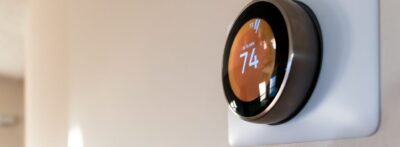
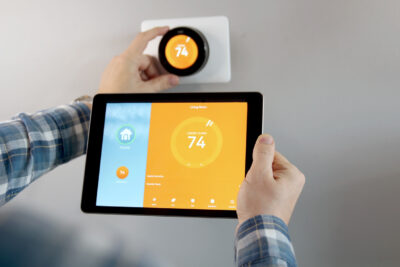 Some utilities now offer incentives to customers in exchange for the ability to control the smart thermostat when power demand is high. The utility’s control is often minimal and customers can typically override the utility setting, but a utility in Colorado recently locked thousands of customer thermostats during an “energy emergency.” If you enroll in this kind of program, be sure you understand what you may give up as a participant.
 How close is the smartphone or laptop you’re reading this on from your eyes? Probably just a few inches. How long have you spent looking at a screen today? If you’re close to the average it’s likely to be over nine hours.
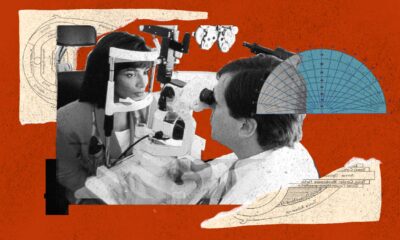 Straining vision introduces a host of eye-related health problems. And it’s more than just kids needing prescriptions. “People say ‘oh, it’s just glasses,’” says Dr Aaron Miller, a pediatric ophthalmologist at Houston Eye Associates. “The nearsighted have much higher chances of retina tears and glaucoma, bigger issues secondary to nearsightedness. It’s the long game we worry about.”
 In what now feels like an annual update, crows are even more surprisingly smart than we thought. But do they have true consciousness? Research shows that crows and other corvids “know what they know and can ponder the content of their own minds,” according to STAT. This is considered a cornerstone of self-awareness and shared by just a handful of animal species besides humans.