
 Self-regulation, within the space of wellbeing, is actually emotional self-regulation. In other words, the capacity of managing our emotions on a daily basis. During the day, we experience a range of different emotions, from joy, love, and peace to anger, frustration, anxiety — and the way we respond to events will determine our state of being. The important point here is that we have a choice, we always have a choice: we can choose to give free rein to negative emotions and dwell on them, or we can choose to acknowledge these emotions, find a solution, and move on.
In my opinion, free will is the faculty of choosing what is best for us. Now, here is when we can start talking about self-mastery, because there is a slight difference between self-regulation and self-mastery.
What is self-mastery? According to the Merriam-Webster Dictionary, self-mastery is the ability to control one’s own desires or impulses. However, when we are talking about consciousness, the meaning of self-mastery becomes a bit broader, because it also means to have the ability to act in certain challenging situations in a controlled manner, peacefully and harmoniously. There are many techniques out there to help us with this process, because it really is a process. Self-mastery is not something that you are born with, it is a quality that you acquire through your life’s journey, and many of us never get it completely.
The first step to self-mastery is actually acknowledging that there is such a thing. People in general are pretty good at controlling themselves, at self-regulating themselves, but when it comes to basic emotions like anger, for example, only a few can say that whatever the situation they are in, they are able to remain calm and composed. Therefore, first we need to incorporate into our vocabulary the word self-mastery, and comprehend and experience its meaning.
The second step is to practice self-regulation to get closer to self-mastery, which is not an easy task. How do we do this?
There are a few steps you can take, for example:
- breathe deeply when confronting a difficult situation
- count to 10 to calm yourself
- go outside to get fresh air
- close your eyes for a while
- feel your heart beating and try to pace it, etc.
Now, you can certainly try all of these easy actions and not see results, or maybe you can find one or two that work, but not all the time. In these instances, keep trying until you find what is best for you.
 The third step is when consciousness comes into play. When I say “consciousness” I am talking about that inner awareness of being more than flesh, being part of something larger, where we are one and unique, where there is peace and there is freedom. As conscious beings we know that our inner self plays a role in our wellbeing, and if we are able to go to that internal place, then we can receive the benefits of understanding that everything comes from within and that we are in charge of our own life.
Several tools give us the power of self-mastery. The regular practice of meditation or any other techniques that awaken and elevate our consciousness will make our life in this physical field more masterful. The idea and intention is to become little Buddhas, remaining calm and composed in the face of adversity — and in happy times, too.
Find our own unique way to connect with the Source. You might call it Spirit, the Great Architect, Archetypal One, Origin, whatever you prefer, because when we are wired to those realms of consciousness we experience deep inner peace and harmony and we become co-creators, together with the Source. We then are attuned to the fields of superior perfection.
Let’s recap:
- Acknowledge that self-mastery is not only a concept, it is a way of being.
- Practice self-regulation techniques, which get you closer to self-mastery.
- Be aware of being more than a body, and that everything comes from within.
- Find a way to connect with the Source and co-create your daily life from this connection.
Through practice and discipline, we can face any situation in a state of inner peace and calmness. Sure, from time to time we might forget that we are here to learn to create with love, and that self-mastery is the most important component of this learning. However, I can assure you that if we are able to pause, rethink and change our ways of reacting, sooner than later we will achieve self-mastery and accelerate our process of ascension.
About the Author:

Veronica Sanchez De Darivas is Chilean-Australian, now living in the UK and a proud mother of teenage twins. A spiritual awakening teacher, bestselling author, pineal gland (third eye) activator and Certified Instructor for the Cyclopea Method, Veronica is currently the only instructor in the world teaching the Cyclopea Method in English.
 A dear friend — a friend I admire for her ability to guide others — recently admitted to suffering from a bout of the “shoulds.” She pointed out that every time she told herself she “should” have done something or “should” be doing something, she was essentially flagellating and shaming herself.
 A propensity toward a “should” mindset can come from early neural imprinting within fear-driven cultures, says neuroscientist Tara Swart, author of The Source: The Secrets of the Universe, the Science of the Brain. “Cultures can mean family, society, school, or religion. Even in adulthood, the ‘shoulds’ are about the things you had to do to survive without punishment, which can be literal or be shame, guilt, or humiliation.” Telling ourselves we “should” be doing this or “should” be doing that subconsciously brings up the shame or guilt that would have been the punishment for not behaving as expected during childhood, says Swart.
 Barna Abel says, situation permitting, her first step in quelling the inner “shoulds” is to check in with herself and ask what would it look like to let go of what she thinks she should do and actually start to do what she wants to do. “It’s just stopping and being honest with yourself about your resistance. A lot of times, what gets stuck in the ‘shoulds’ are things that we’re not good at. There are things you may have been putting off because they aren’t things you really want to do, or are things that you may find difficult,” Barna Abel says. Then, actually plot out your options. “Ask yourself: If I knew I couldn’t fail, success was assured, and money was no object, what would happen? This gets you to open up in terms of possibility and alternate solutions,” she adds.
 Welcome to Summer! Welcome to Winter! Completely depends on whether you’re in the Northern or Southern Hemispheres, doesn’t it? Still, happy Solstice to one and all.
 We are currently the only species on this planet in which everyone must “earn” their living. Do you even ever question that assumption? I do…a lot. Jobs were created when the Industrial Age started. Before that everyone had a trade or vocation. People specialized, whether they were the baker, butcher, or candlestick maker. Everyone was sort of an entrepreneur. Before that, we lived in cooperative communities in which everyone contributed to the mutual welfare and survival of all the members of the group. Concepts such as hoarding and “not enough” were unknown. Yes, there were tough times; when the hunting was poor, or there was a drought. But the fluctuations were part of the planetary ecosphere evolving, not because someone somewhere saw a way to make a quick buck speculating in the commodities market. We might well ask what changed to cause us to abandon the natural equilibrium we had with Nature and when and how did it change. Is what we see in front of us now really fair and working for you and me?
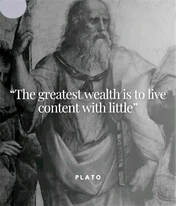 A new thought teacher by the name of Catherine Ponder once said, “abundance is having just enough to share.” When we share from our blessings, no matter how meager, we are sending out a message to the Universe. We have cast our “bread on the waters” which will return to us when we may be in need. As we give to others, we give to ourselves.
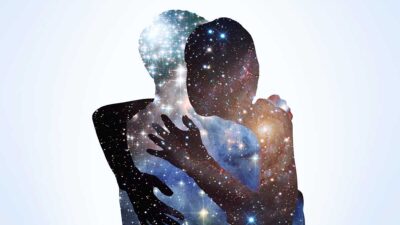 Tina was at a crossroads. Her daughter had recently left for college, and her husband had his own pursuits. And although she’d once enjoyed banking, she now bore little interest in her work. For some time, she had been asking herself whether she should quit. But what would her colleagues and bosses think of her?
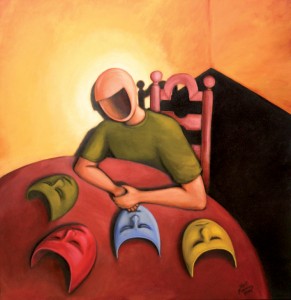 The idea of a “true self” and a “false” or “shadow” self has long preoccupied psychologists. For example, Carl Jung introduced the notion of the shadow side of our personality. He viewed “the shadow” as our unknown, dark side—made up of the primitive, negative, socially depreciated human emotions such as sexuality, striving for power, selfishness, greed, envy, jealousy, and anger. But although the shadow personifies everything that we fear, and therefore refuse to acknowledge, it remains a part of us. Jung believed that unless we come to terms with our shadow side, we are condemned to become its unwitting victim.
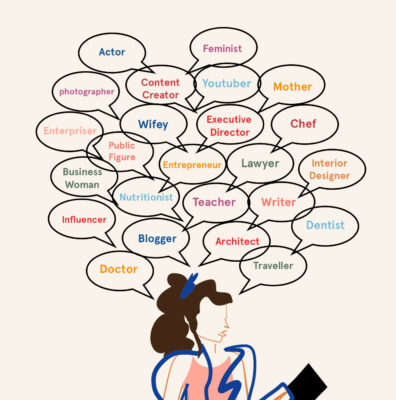 If there is too great a discrepancy between the “true” and the “false” self, it will make for a vulnerable sense of identity. And if we are unable to acquire a stable sense of identity—we may end up one day unraveling as Tina did. After a lifetime of complying to others’ expectations, Tina was experiencing what Erikson would call a delayed identity crisis. At a certain point in her life, it became difficult for her keep up the lie.
 Yesterday I was chatting with a friend and I found myself saying the words ‘tipping over the vibrational horizon’. I had never used those words before so I set out to discover exactly what I meant by this.
 Alchemy has always seemed a somewhat mysterious ability to many people. The word itself evokes a level of power that, in the past, many have been frightened to step into.
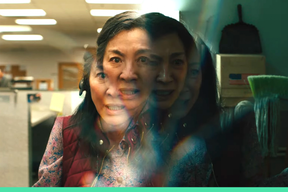 Yes, I have blatantly plagiarized the title of a recently released film starring Michelle Yeoh. I’ve not even had the pleasure of seeing this work of cinematic art yet, but I am familiar enough with the plot to know that the central character could represent any one of us. If you’ve seen it, you will know what Michelle’s character is facing. An audit by the Internal Revenue Service, and dilapidated laundry business barely able to provide a living for her and her bumbling husband, and strangers popping in from the future asking for her help to save the world. All in a day’s work I’d say!
 The other side of this circus is the possible reality that unity consciousness might bring to us if we had every barrier to it suddenly lifted. We just might flame out and disappear with the sheer immensity of seeing, knowing, and feeling everything, everywhere, all at once. Is that what Spirit/God/Goddess/All That Is experiences? How can one know for sure? How in the heck does the Great Spirit cope with all that anyway? These are some of the questions that I entertain when I wake up in the middle of the night.
 On June 11th at 11:51pm BST (10:51pm UT) transiting Venus meets up with and kisses Uranus at 16 degrees of Taurus. Can you say “unusual” or “unconventional” when it comes to sexual loving, flings with the opposite or same sex, and coming to terms with what our true natural values and needs are as regards our sexuality? I knew you could. This transit is brief but can certainly upend your own status quo regarding sexuality, which may lead you into unusual encounters with possible partners or with society at large (“…that is indecent and immoral, and you need to stop that now!”). You get my drift. Judgment always crops up when Uranus is in town and is wearing a bull costume. You may also have unusual and possibly revelatory experiences with your own sexual nature. Uranus encourages exploration and trying new things, so this weekend could be interesting! If you in fact have any aspects to anything at 16 degrees of Taurus, Scorpio, Aquarius or Leo, you may feel this “hit home”. The potential stinger in this conjunction could be a further eroding of the value of Bitcoin, fiat currencies (paper money), and digital money (the M3 money supply). The almost hyperinflation happening is definitely tied to Uranus in Taurus, as is the deflation of cryptocurrency values.
 What’s the point of networking if not to get other people to like you? Sure, you need new contacts to see you as interesting, competent, professional, and potentially valuable to them—but if they don’t also find you likable, nobody will feel motivated to reach out later and work with you.
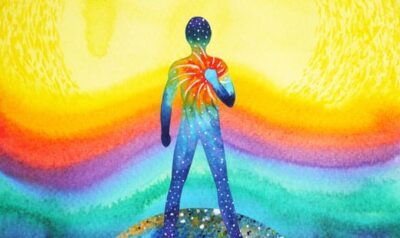 I am always careful when using phrases and sentences saying something like, “Be you”, “Discover yourself “, or “Be authentic”. I admit that this kind of statement puts me off. However, sometimes it is difficult to express experiences that happen to us at a deep inner level, and I have come to the conclusion that, no matter what, words are here to be used the way we know and when adding the feeling from which they are expressed, any word gets validated.
 Everything is energy and science has been talking about it for quite some time now: think of Einstein and his famous formula, E=mc2. Remember Nikola Tesla as well, who said, “If you want to find the secrets to the universe, think in terms of energy, frequency and vibration.”
 The first time I put up a one person show, I didn’t know what I was doing.