
 A few months ago, I was introduced over email to a consultant, who I’ll call Brad. The person who made the introduction thought Brad would make a good contributor to Harvard Business Review, where I work as an editor. I receive a good number of these introductions, and when this one came in, I was particularly overwhelmed with requests. Brad asked if we could get on the phone to talk. I courteously declined and let him know that an editor would be in touch about the draft he submitted.
A few weeks later, he asked again. Again, I sent what I thought was a polite response explaining that because of the demands on my time, I wouldn’t be able to have a call with him. Then I got this email from Brad: “We’re all busy but human connection is the most important thing. I’m going to take my writing elsewhere. I can’t handle the ego.”
This wasn’t the first time I’d dealt with a frustrated would-be author. But this one got to me. I reread his note a few times, my heart rate increasing and my shoulders and neck tensing. Initially, I thought that it was all Brad’s fault. That soon morphed into self-doubt. I started to wonder if he was right. Then, I took a few deep breaths and did what I thought was right: I deleted the email.
After hitting delete, Brad’s email kept popping into my mind. When I was making dinner that night, I thought about the line “I can’t handle the ego.” And at 3:00 a.m. the next morning, instead of falling back to sleep, I was still thinking about it, and beating myself up for not being able to let it go.
When interacting with someone challenging, our brain wants to protect us from harm. In the process, however, it often holds us back. I decided to let Brad’s email go, shrug it off, and move on. But my brain was hooked on the interaction.
Our brains on conflict
When we experience or perceive a potential rupture in our relationship with another person, our brain reacts as if we’re in actual danger. It prepares our body to respond to that perceived threat while attempting to make sense of what we’re experiencing.
On each side of our brain, behind the optical nerves, there’s an amygdala. One of its functions is to detect fear and then prepare the body to respond appropriately. So, when you perceive a threat, the amygdala begins to react by signaling the release of stress hormones like cortisol and adrenaline.
These instinctual responses save time and energy and often do keep us safe. If you’re standing in the middle of the road and there’s a car bearing down on you, it would be dangerous if your brain paused to think. You need it to react instinctively and tell your body to get out of the street as quickly as possible.
How mental space prevents amygdala hijack
The more you can observe your instinctive reactions when your mind senses a threat, the better you’ll get at separating the stories your brain cooks up from what’s actually happening. Once you’ve created a little space from a vexing episode, you can then reappraise it. Psychologists have found that reappraisal—reassessing an emotional situation in a more positive or neutral light, or as a challenge instead of a threat—helps people focus and make more considered decisions about how to proceed.
Pay attention to your stress levels
When stress is running high, you become more susceptible to the pitfalls of an amygdala hijack. Having a simple list of questions on hand for fraught situations could be the difference between losing your cool and finding a productive way forward. Here’s a mental checklist that I use when I notice that I’m going into an amygdala hijack:
- Am I hydrated?
- Am I hungry?
- How did I sleep last night?
- What else am I worried about?
- Do I have any big projects or deadlines weighing on my mind?
- Are any of my important relationships with friends or family strained right now?
- When was the last time I did something that I enjoyed?
Monitoring your mental resources in this way can help you gain perspective. Throughout 2020, I had to remind myself regularly that the cognitive load of living through a pandemic made me much more prone to interpret the behavior of those around me as threatening, mostly because I already felt threatened. And when you’re in survival mode, you don’t have the reserves to tolerate additional stress.
The power of time
Often, getting a good night’s sleep is exactly what you need to change your mindset. Alice Boyes, the author of The Anxiety Toolkit, helped me understand that while our initial response to a coworker talking over us in a meeting (again) or not following up on a task they promised to get done may be intense, those negative emotions don’t usually persist.
Let’s go back to my incident with Brad. I noticed the following day when I woke up that I cared less about what had happened. I didn’t really think about it during the day. Each day passed, and I thought about it less and less. As I’m writing this now, I actually care almost not at all—almost.
Give yourself time away from thinking about issues you’re having with a coworker. Consider taking a break. Get outside or listen to your favorite song—anything that pulls your attention away from your colleague for a bit. Then return to the interaction later and see if you have a different point of view once you’ve gotten out of the amygdala hijack.
That’s not to say you should completely ignore conflict or pretend it doesn’t bother you. Boyes says that thinking about challenging situations can actually be helpful, as long as your mind is focused on problem-solving and not rumination or perfection.
Our minds can often work against us in these moments of conflict. But we can use the same brain science in our favor. One way to do this is to remind ourselves that the other person may be going through the same thing. It might not be their intention to hurt you, lash out at you, or make your life miserable—perhaps they’re in an amygdala hijack and aren’t thinking clearly. Seeing an adversary as a person with a brain that works in the same—sometimes flawed—way that yours does can be the first step toward creating a better relationship.
Original article here
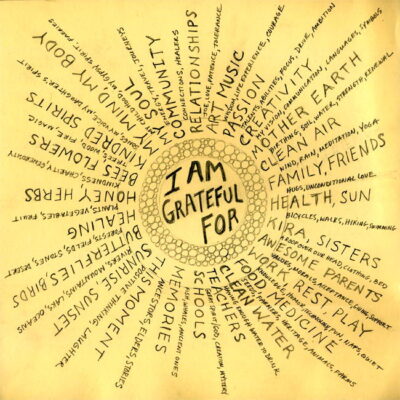 In Sidetracked: Why Our Decisions Get Derailed, and How We Can Stick to the Plan, Francesca Gino, an associate professor at Harvard Business School, explores a range of fascinating subjects, including how emotions influence decisions and the often-thorny matter of understanding the perspectives of others. Blending social science and real-world examples, Gino’s book also highlights the science of gratitude.

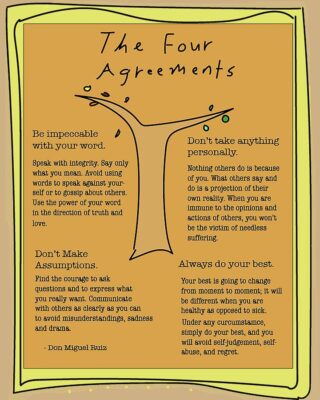 Spiritual teacher Don Miguel Ruiz brought The Four Agreements into Western awareness. A new thought author versed in ancestral knowledge, Ruiz says the agreements come from Toltec wisdom. The Toltecs were a pre-Hispanic culture living in central Mexico, talented artists and builders as well as warriors.
 In the run-up to marriage, many couples, particularly those of a more progressive bent, will encounter a problem: What is to be done about the last name?
 In a forthcoming study, Kristin Kelley, a doctoral student working with Powell, presented people with a series of hypothetical couples that had made different choices about their last name, and gauged the subjects’ reactions. She found that a woman’s keeping her last name or choosing to hyphenate changes how others view her relationship. “It increases the likelihood that others will think of the man as less dominant—as weaker in the household,” Powell says. “With any nontraditional name choice, the man’s status went down.” The social stigma a man would experience for changing his own last name at marriage, Powell told me, would likely be even greater.
 That’s what legendary Vietnamese Zen Buddhist monk, teacher, and peace activist Thich Nhat Hanh (October 11, 1926–January 22, 2022) explored in How to Love — a slim, simply worded collection of his immeasurably wise insights on the most complex and most rewarding human potentiality.
 And yet because love is a learned “dynamic interaction,” we form our patterns of understanding — and misunderstanding — early in life, by osmosis and imitation rather than conscious creation. Echoing what Western developmental psychology knows about the role of “positivity resonance” in learning love, Nhat Hanh writes:
 In 2007, a group of researchers began testing a concept that seems, at first blush, as if it would never need testing: whether more happiness is always better than less. The researchers asked college students to rate their feelings on a scale from “unhappy” to “very happy” and compared the results with academic (GPA, missed classes) and social (number of close friends, time spent dating) outcomes. Though the “very happy” participants had the best social lives, they performed worse in school than those who were merely “happy.”
 Life has sped up. A never-ending stream of stimuli is vying for your attention every minute of the day. Some of it is fabulous and some of it is time wasting.
 In a world where it is almost impossible to lose contact with friends, thanks to the likes of social media, this regret may seem irrelevant. You can send someone a text to say you’re thinking of them, comment on their Facebook feed or Instagram photo, or chat via Messenger. But how long is it since you’ve really connected with these people in real life? How long since you’ve laughed together, cried together, eaten together or just hung out?
 I believe in angels. I feel their presence in my life every hour, minute and second, I know they are with me, with us, but how? From a rational point of view, it is probably impossible to explain their existence, however I can say that they are part of my experience.