

 The herd of 400-pound caribou was running 50 miles an hour and directly at me. The 30 animals had been eating lichen in the Arctic tundra in Alaska when something spooked them. I was sitting in their escape route. The ground began to vibrate once they cracked 100 yards. At 50 yards, I could see their hooves smashing the ground and kicking up moss and moisture. Then they were at 40 yards, then 35.
I could hear their breathing, smell their coats, and see all the details of their ornate antlers. Just as I was wondering if the rescue plane would be able to spot my hoof-pocked corpse, one of the caribou noticed me and swerved. The herd followed, shaking the earth as they swept left and summited a hillcrest, their antlers black against a gold sky.
That moment when those caribou shook the earth also shook my soul. It was transcendent, wild as a religious experience. And it’s not even the most intense thing I did in Alaska. I experienced savage weather, crossed raging rivers, and faced a half-ton grizzly. My brain was feeling less hunkered down in its typical foxhole—a state I’d compare to that of a roadrunner on meth, dementedly zooming from one thing to the next. My mind felt more like it belonged to a monk after a month at a meditation retreat. I just felt . . . better. The biologist E. O. Wilson put what I was feeling this way: “Nature holds the key to our aesthetic, intellectual, cognitive, and even spiritual satisfaction.”
When I returned from the wild, my Zen-like buzz hung around for months. To understand what was happening, I met with Rachel Hopman, Ph.D., a neuroscientist at Northeastern University. She told me about the nature pyramid. Think of it like the food pyramid, except that instead of recommending you eat this many servings of vegetables and this many of meat, it recommends the amount of time you should spend in nature to reduce stress and be healthier. Learn and live by the 20-5-3 rule.
20 Minutes
That’s the amount of time you should spend outside in nature, like a neighborhood park, three times a week. Hopman led a new study that concluded that something as painless as a 20-minute stroll through a city botanical garden can boost cognition and memory as well as improve feelings of well-being. “But,” she said, “we found that people who used their cell phone on the walk saw none of those benefits.”
Other research discovered that 20 minutes outside three times a week is the dose of nature that had the greatest effect on reducing an urban dweller’s levels of the stress hormone cortisol.
In nature, our brains enter a mode called “soft fascination.” Hopman described it as a mindfulness-like state that restores and builds the resources you need to think, create, process information, and execute tasks. It’s mindfulness without the meditation. A short daily nature walk—or even a walk down a tree-lined street—is a great option for people who aren’t keen on sitting and focusing on their breath. But turn off your phone—alerts from it can kick you out of soft-fascination mode.
5 Hours
The minimum length of time each month you should spend in semi-wild nature, like a forested state park. “Spending more time in wilder spaces does seem to give you more benefits,” said Hopman.
A 2005 survey conducted in Finland found that city dwellers felt better with at least five hours of nature a month, with benefits increasing at higher exposures. They were also more likely to be happier and less stressed in their everyday lives.
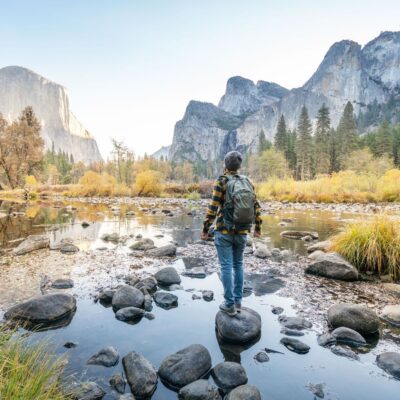 The Finnish government then funded another study in 2014 in which the scientists dumped people in a city center, a city park, and a forested state park. The two parks felt more Zen than the city center. No shocker. Except that those walking in a state park had an edge over the city-park people. They felt even more relaxed and restored. The takeaway: The wilder the nature, the better.
Nature has these effects on the mind and body because it stimulates and soothes us in unusual and unique ways. For instance, in nature you are engulfed in fractals, suggested Hopman. Fractals are complex patterns that repeat over and over in different sizes and scales and make up the design of the universe. Think: trees (big branch to smaller branch to smaller branch and so on), river systems (big river to smaller river to stream and so on), mountain ranges, clouds, seashells. “Cities don’t have fractals,” said Hopman. “Imagine a typical building. It’s usually flat, with right angles. It’s painted some dull color.” Fractals are organized chaos, which our brains apparently dig. In fact, scientists at the University of Oregon discovered that Jackson Pollock’s booze-and-jazz-fueled paintings are made up of fractals. This may explain why they speak to humans at such a core level.
Nature lifts us in other ways, too: Think smells and sounds. The feeling of the sun’s warm rays. Or just the fact that you’re getting out of the stress of your home or office. “It’s probably a mix of a lot of things,” said Hopman. Environments like cities, with their frenetic pace, right angles, loud noises, rotten smells, pinging phones, and to-do lists, don’t offer this.
3 Days
This is the top of the pyramid. Three is the number of days you should spend each year off the grid in nature, camping or renting a cabin (with friends or solo). Think: places characterized by spotty cell reception and wild animals, away from the hustle and bustle.
This dose of the wildest nature is sort of like an extended meditation retreat. Except talking is allowed and there are no gurus. It causes your brain to ride alpha waves, the same waves that increase during meditation or when you lapse into a flow state. They can reset your thinking, boost creativity, tame burnout, and just make you feel better.
This is likely why one study found that three days in the wild boosts creativity and problem-solving abilities and another found that U. S. military vets who spent four days white-water rafting were still buzzing off the wild a week later. Their PTSD symptoms and stress levels were down 29 and 21 percent, respectively. Their relationships, happiness, and general satisfaction with their lives all improved as well.
When I returned from Alaska, my wife and I moved to the edge of the desert in Las Vegas. She wanted a shorter commute, and I wanted more access to nature. I now walk my dogs through red-rock trails for at least 20 minutes daily and on Sunday do a long trail run deep into the canyons to rack up my five-hour quota for the month. This summer, I’m planning a weeklong backcountry fly-fishing trip in Idaho’s Frank Church–River of No Return Wilderness Area. Hoping I’ll return less frazzled, fitter, and feeling more alive.
Original article here
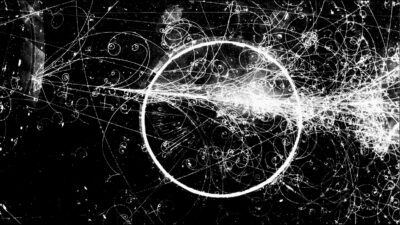
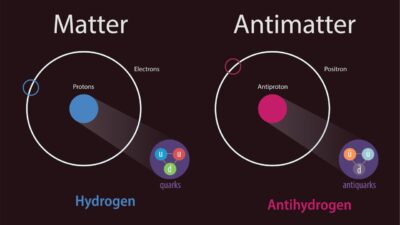
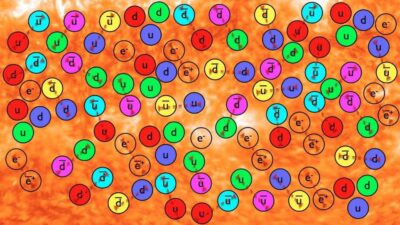
 So that’s how the hot Big Bang starts off: with this hot particle-antiparticle soup made up of all allowable species. In the earliest stages, it’s the heaviest particle-antiparticle pairs that disappear first. It takes the most energy to create the most massive particles and antiparticles, so as the Universe cools, it gets progressively less and less likely that the quanta of energy that interact can spontaneously create new particle/antiparticle pairs.
 However, since there is somewhere around 1 extra proton (or neutron) for every 1.4 billion proton/antiproton pairs, we’re left over with a small excess of protons and neutrons.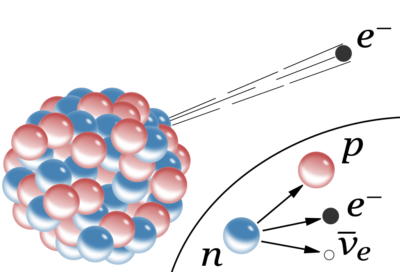
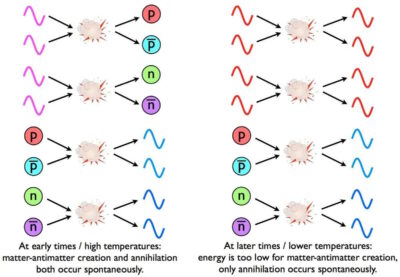
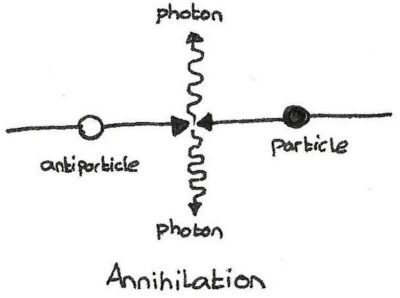
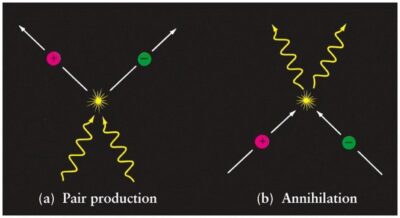 On the other hand, the Universe is still energetic enough that when two photons collide, they can still spontaneously produce electron-positron pairs, and where electron-positron pairs annihilate into two photons. This continues for just a tiny bit longer: until the Universe is about three seconds old (as opposed to the one second freeze out for neutrinos). This “second additional thing,” occurring just slightly after the weak interactions freeze out, means that all the matter-antimatter energy that was tied up in electrons and positrons goes exclusively into photons, and not into species of neutrinos-and-antineutrinos, when they annihilate.
 Microplastics are turning up everywhere, from remote mountain tops to deep ocean trenches. They also are in many animals, including humans.
 I bike the same route to my job every morning. Turn right, over a bridge, gentle left, hard left, hard right, check for cars at the 4-way stop, left turn, gentle right, huff and puff up the same long hill… and on I go. I can recite the entire route from memory. Same streets, same houses, same trees, same lake, same parks, all whizzing by as I focus on the road ahead, keeping up my speed to get a good workout and get to work on time.
 I was asked recently how we can find happiness in this world that contains so much conflict and suffering. I find happiness because I look for it, right where I am, just like Joanne did. There are tiny flowers on the ground and funny bumper stickers on people’s cars. The person who walks past me has a face, and it might smile if I smile at them. When I look as a beginner looks — as if I haven’t already seen a million flowers, read all the bumper stickers, passed so many faces in my lifetime — I experience these little joys.

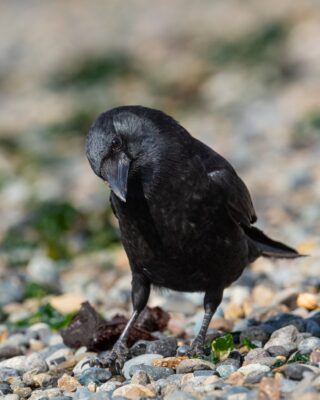 In what now feels like an annual update, crows are even more surprisingly smart than we thought. But do they have true consciousness? Research shows that crows and other corvids “know what they know and can ponder the content of their own minds,” according to STAT. This is considered a cornerstone of self-awareness and shared by just a handful of animal species besides humans.
 The tantalising theory that a fifth force of nature could exist has been given a boost thanks to unexpected wobbling by a subatomic particle, physicists have revealed.