 I am having one of those days where my thoughts are leaning towards anticipating negative scenarios and engaging in the “what if’s” the mind is so compelled to do. And while, at this point, I know enough of the machinations of the mind to not go down those rabbit holes, it still can nag away at me as it was doing on this particular day.
While I have many techniques I use to bring my mind back into balance, something happened quite naturally on this day that really struck me. After a walk with my husband where I had laid out my potential what if’s, we made our way over to gather eggs and look at what was happening with the starts and seeds we had recently planted.
It took no time at all for my anticipating mind to tune into something life-giving, shifting me out of a chaotic mind to one quite naturally and easily at peace — a mind at ease as it found itself immersed in the bigger picture of life. All of this with no effort on my part, other than to be in relationship with something greater than myself, while spontaneously repeating over and over, “just this,” as I moved through the garden.
The “just this” was my way of focusing only on what was right before me — whether that was the lettuce I was picking, the conversation I was having or the observations I was making of the seedlings, — in effect, immersing my mind in the right now versus the “what if” future.
We take whatever we think to be true as something to believe in and act on, even when all signs point to the fact our minds have gone off the rails with fear, anxiety and judgment. And while in this day and age there is no end to solutions for an imbalanced mind from medication to meditation, we often skip right over the most accessible and effortless of approaches to healing our minds — the natural world.
Our very home and all the elements and conditions and living beings that we have co-evolved with since we first appeared on the planet are the clearest reflection of who we are, where we come from, and what we need. Why would we go anywhere else to gain perspective and to ground ourselves in truth?
We have been conditioned to believe that our well-being resides in a screen, a pill, more stuff, more prestige, more likes, etc. We have come to experience ourselves as separate from, and therefore not needing the support and the tutelage of what Earth has to offer us. Unfortunately, many of us have strayed so far and for so long, we have come to see the natural world as foreign, dark and scary, an enemy as opposed to an ally.
We are nature herself. We are created and sustained by the same force. To know this is to tap into the good news that even if we have forgotten, even if we never learned to begin with, all we have to do is to put ourselves in the presence of the natural world for it to do its work on us.
Find a reason every single day to linger, even for one minute, somewhere outside. Go without agenda. Go and be a listener. Go and allow yourself to get lost in the breeze, a bird singing, some fragrance, a starry night, the feel of rain on your skin. And say to yourself, “just this.”
Original article here

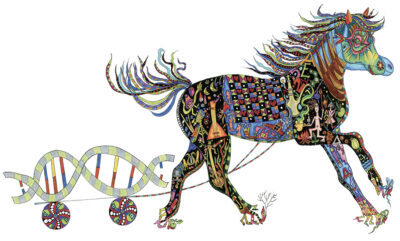
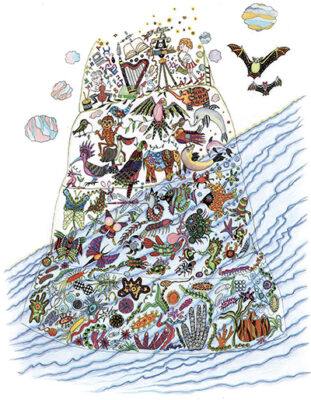
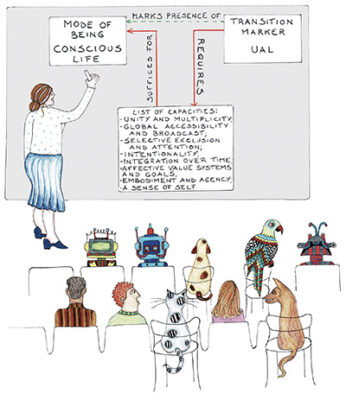
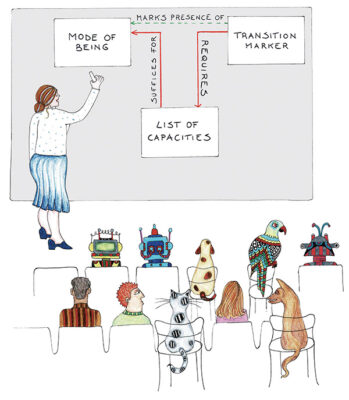 A consensus list of consciousness capacities is a step forward, but identifying each and every capacity may be difficult, and a list does not tell us how they interact to form a conscious being. If we could find a single system-property — an evolutionary marker of consciousness — that indicates that the organism has evolved all the capacities in the consensus list, we would be in a much better position. Finding such a single, diagnostic transition marker would make it possible to identify the simplest evolved conscious being, reconstruct the processes and structures that underlie it, and figure out how they interact. If we can follow the evolution of the marker and therefore the evolution of consciousness, we can discover when and how the conscious mode of being originated.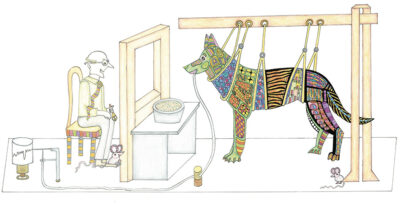
 The study of associative learning today includes the investigation of the underlying cognitive and neurobiological mechanisms in ecologically relevant conditions such as the social conditions in which animals learn from each other. It is a rich and productive research program, which is no longer constrained by the behaviorists’ maxims. There is an irony in our (qualified) return to the 19th-century suggestion that open-ended associative learning is an evolutionary transition marker of consciousness, the very term that behaviorists tried to purge from psychology.
 (i) It can distinguish between novel complex patterns of stimuli and actions. For example, it can learn to navigate in a new terrain — to discriminate between different types of animals, between different routes leading to food and shelter. The learned patterns are genuinely novel: they are not reflex-eliciting patterns, nor have they been learned in the past.
 Animals that could mitigate the high costs of UAL without giving up its benefits would have a great advantage. The evolutionary elaboration of the ubiquitous stress response and the evolution of active forgetting are some of the ameliorating mechanisms that we expect to find in all associatively learning animals, and in particular, in UAL animals. Suffering was not eliminated, but it became more controlled.



 We hate to sound like a broken record, but it really is crucial to incorporate lifting weights into your workout regimen. In fact, when it comes to exercise for older adults, strength training actually trumps cardio because preserving muscle is more important than losing fat as you age.