

In a recent article in the Financial Times, Markham Heid shares with us a peculiar life crisis. At 41, he has built what many would regard as the good life: he has a family; he is healthy, productive, and creative; he has time to travel, read, exercise, and see friends. Yet, he feels that “something is off.” He gives this state a variety of names, including mid-life melancholy, ennui, and despair. He also diagnoses it in others all around him. To fight against it, some of his friends have turned to ayahuasca retreats, others to fitness. What renders Heid’s malaise somewhat strange is that it does not seem to arise from anything specific. If Heid had lost his job, had no time for himself, or was struggling in his marriage, some of these feelings would seem less puzzling.
In the history of philosophy, there have been many attempts to understand such powerful but objectless feelings. Boredom, anxiety, and despair are some of the descriptions these moods have received. In the novel Nausea, the French existentialist philosopher Jean-Paul Sartre describes someone who mysteriously experiences that feeling whenever they are confronted with ordinary objects, like a pebble on the beach. The German philosopher Martin Heidegger describes an uncanny unease we may feel when we are bored and searching desperately for distractions. The Danish philosopher Sшren Kierkegaard speaks of a silent despair in the background of our lives, a sense of discord or dread of an unknown something that can grab us momentarily.
Sadly, the philosophical descriptions of such moods have often been misunderstood as sombre or romantic moments of existential reflection where we recognize our mortality or the meaninglessness of life. Pictured in this way, these moments are bound to stay isolated from the anxiety, despair, and melancholy that we face in our ordinary life and seek help for. But if we look beyond the existentialist cliches, the philosophical ideas on such moods can offer a new way forward. What could Heid have learnt from the philosophers?
Moods of nothing
Despite Heid’s references to Heidegger, we do not read anything about the philosopher’s own ruminations of a very similar experience of flatness: a feeling that all things (and we ourselves) sink into indifference; a sense that things around us slip away or we slip away from ourselves; a malaise related to a vacant stillness. What is remarkable, for Heidegger, is that such intense affects arise despite the fact that nothing may have changed in our lives: one is still surrounded by the same people, events, and activities, but these do not engage us as they used to. It is this feature that makes him describe what he calls “anxiety” as a mood generated by nothing in particular.
 This makes such feelings doubly unwelcome. Most of us can tolerate negative emotions if we see them as instrumental to something desirable—we do not run to a therapist to treat a fear if we think that it holds us back from doing something obviously risky. But unlike fear, what Heidegger calls anxiety and what Heid’s article describes do not protect us from anything specific. No wonder why Sigmund Freud called anxiety a “riddle.”
But this view is too simplistic for Heidegger. It risks concealing both the value and meaning of the feelings he describes. First, the human emotional life is much more complex than a simple battle between positive and negative feelings, or useful and useless emotions. Second, objectless moods can teach us something significant not about specific risks or problems in our lives but about the fact that we have a life to live at all. Learning from them can allow us to find what Heidegger describes as a sense of peace and joy within the malaise.
What’s missing?
Heid says that “some essential aspect of life is missing or not sufficiently represented.” He ends up attributing his melancholy to the lack of new experiences. Kierkegaard calls this the illusion of “crop rotation,” the idea that changing the soil frequently can save us from boredom and despair.
But what really drives such moods is not the need for new experiences. It is not even the particulars of our individual lives or the culture we belong to, but that we have been given a life to live in the first place, the taste of possibility that comes with being alive. The kinds of questions that arise are not questions like “have I married the right person?” “will parenthood enrich my life?” or “do I have enough hobbies?” It is the more fundamental questions like “what does it mean to be human?” “what am I supposed to do with the fact that I was given a life?” and “what kind of life is possible for me?” that best explain our human tendency for anxiety, despair, or boredom.
This is why such moods are likely to appear as a mid-life crisis. With many of our life goals fulfilled, we start to wonder what life is for, what is possible for human existence, and what we are doing for it. Humans are inherently ambivalent toward possibility, attracted but also repelled by it. On one hand, we can experience it as a radical openness, an appreciation of our life as a gift. On the other, the open-endedness of possibility, the sense that one could always be doing more with their life, can create a great sense of agony about who we are and how we should go on.
Throwing us out of our everyday lives, such moods make us ponder existence itself. They are cases where who we are and what we are for becomes an issue for each one of us. These questions never assume a final answer. Hovering over our lives, they can always leave us with a sense of unease. Recognizing that these questions are there, and that they matter, can at least allow us to know what may be missing, even when all is good.
Original article here


 I am having one of those days where my thoughts are leaning towards anticipating negative scenarios and engaging in the “what if’s” the mind is so compelled to do. And while, at this point, I know enough of the machinations of the mind to not go down those rabbit holes, it still can nag away at me as it was doing on this particular day.
 Potts stresses that his “mum brought me up good and proper” – but as a teenager growing up in Salford, he started getting into trouble. “We’ve had our hard times with Stuart, but a lot of it was typical boy stuff,” his mum, Pat Malone, said. “We used to say he was a lovable rogue.” Potts went to prison several times in his late teens and 20s, including an 18-month stint for beating up a burglar who had broken into a friend’s house. After he got out, he had a chequered career: working in factories, as a cobbler, locksmith and painter and decorator. But gradually, life stabilised. He got married, moved into a comfortable council house, and had three kids. Then, in 2016, after more than 15 years, the marriage broke down.






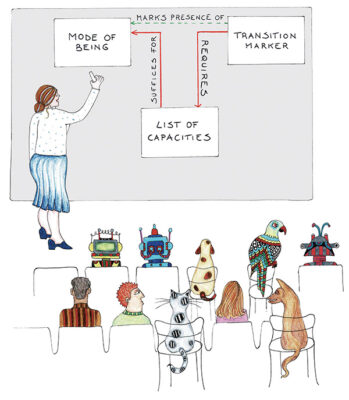 A consensus list of consciousness capacities is a step forward, but identifying each and every capacity may be difficult, and a list does not tell us how they interact to form a conscious being. If we could find a single system-property — an evolutionary marker of consciousness — that indicates that the organism has evolved all the capacities in the consensus list, we would be in a much better position. Finding such a single, diagnostic transition marker would make it possible to identify the simplest evolved conscious being, reconstruct the processes and structures that underlie it, and figure out how they interact. If we can follow the evolution of the marker and therefore the evolution of consciousness, we can discover when and how the conscious mode of being originated.
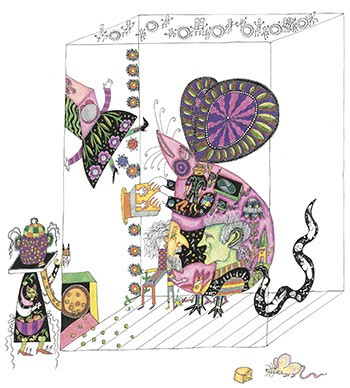 The study of associative learning today includes the investigation of the underlying cognitive and neurobiological mechanisms in ecologically relevant conditions such as the social conditions in which animals learn from each other. It is a rich and productive research program, which is no longer constrained by the behaviorists’ maxims. There is an irony in our (qualified) return to the 19th-century suggestion that open-ended associative learning is an evolutionary transition marker of consciousness, the very term that behaviorists tried to purge from psychology.
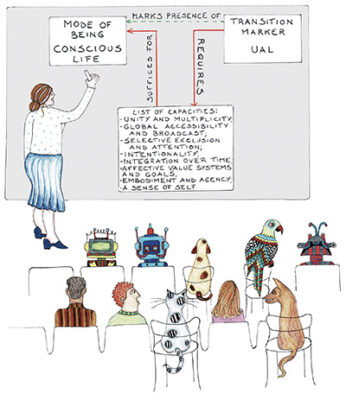 (i) It can distinguish between novel complex patterns of stimuli and actions. For example, it can learn to navigate in a new terrain — to discriminate between different types of animals, between different routes leading to food and shelter. The learned patterns are genuinely novel: they are not reflex-eliciting patterns, nor have they been learned in the past.
 Animals that could mitigate the high costs of UAL without giving up its benefits would have a great advantage. The evolutionary elaboration of the ubiquitous stress response and the evolution of active forgetting are some of the ameliorating mechanisms that we expect to find in all associatively learning animals, and in particular, in UAL animals. Suffering was not eliminated, but it became more controlled.