

If ‘more sleep’ or ‘less stress’ are goals for you, then you’ll probably have tried to introduce a few changes to your routine. You’ve hung blackout curtains, tried to finish dinner by 8pm and stopped scrolling on TikTok in the evenings. And yet, here you are, still feeling tired. Maybe that’s because you’re missing one crucial stress-busting element: the vagus nerve.
“The vagus nerve is responsible for a huge number of signals from the digestive system and organs to the brain and vice versa,” says Dr Deepak Ravindran, author of The Pain-Free Mindset. “It’s an important part of the parasympathetic system, the so-called ‘rest and digest’ part of the nervous system.
“While the sympathetic system is responsible for the ‘fight and flight’ aspect, we need the parasympathetic system in full readiness to support us when needed.”
You can engage this system through vagus nerve stimulation – non-interventional exercises that help improve the tone of the nerve. Dr Ravindran explains: “Vagal tone is an internal biological process that represents the activity of the nerve. Increasing your vagal tone activates the parasympathetic nervous system. Therefore, having a higher baseline vagal tone can allow the body to relax faster after stress.”
So, tone up your vagus nerve and you’ll be mentally and physically fitter to deal with stressful situations. The good news is that there’s a wealth of quick and easy DIY ways to achieve this – from yoga to massage and singing to cold exposure. Here’s what the experts recommend.
Hum, sing and vibrate for more calm
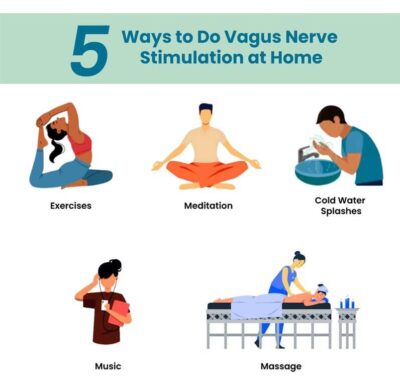 Singing, humming, chanting and even gargling can improve vagal tone because the vagus nerve controls your vocal cords and the muscles at the back of your throat, explains Dr Ravindran. A brain imaging study even found that the humming involved in the meditation chant ‘om’ reduced activity in areas of the brain associated with depression.
That might mean humming your favourite tunes or taking time out to head to a yin yoga class that usually finishes with a spot of class chanting. Yoga instructor Scarlett Woodford tells Strong Women: “When you have a whole room of people chanting it can feel incredibly vibrational and healing.
“However, if this feels a bit overwhelming, the simple chant of ‘om’ on your own is perfect. Try to make each ‘om’ last as long as your natural exhale, with equal parts on both the ‘O’ with an open mouth and ‘M’ with a closed mouth.”
Alternatively, get your cat to do the heavy lifting by sitting on your chest. Not only is a purring cat an immediate comforter, but the furry little things have been proven to stimulate the vagus nerve. Petting your cat for just 10 minutes has been scientifically proven to reduce levels of the stress hormone cortisol, so we all win (well, the cat lovers do).
Give restorative yoga a go
Dr Ravindran recommends exercise, particularly yoga, for improving vagal tone. Yogi and founder of The Yoga Class Laura Dodd finds restorative yoga postures such as supported fish pose or legs up the wall are her go-to moves after a stressful day.
“They truly help me switch off my mind and find a deep state of relaxation,” she says. “As well as stimulating the vagus nerve, the heart-opening nature of these poses helps promote deeper, more effective breathing and relief for upper back and neck tension.”
How to do a supported fish pose (matsyasana)
- Unlike full fish pose, this gentle backbend uses props to promote relaxation. You may wish to use a block under the head, one positioned between the shoulder blades or just a bolster down the length of the spine.
- Lie down on your props with your legs straight and arms relaxed by your sides.
- Feel an opening in the upper chest area and come to a slow, deep belly breath for at least five minutes.
Try applying acupressure to your ear
From massage to hugs, touch is believed to help stimulate the vagus nerve. Manipulating specific acupressure points, however, is thought to have the most profound effect.
“I often suggest massage points to my patients to help them stimulate the vagus nerve and restore calm in their daily lives,” says acupuncturist Saffron Pretty. “My favourites include the ear point ‘shen men’ found in the upper third of the ear just within the shaded part.
“Ideally, this area is best stimulated with firm pressure and an even circular motion using a finger or rounded object while seated or lying down. You can do this several times a day or when going off to sleep at night with attention on the breath to aid relaxation.”
Give breathwork a go
It’s no surprise that slow, deep breathing helps us relax, but a study by the National Yang-Ming University in Taiwan specifically found that slow-paced breathing enhances vagal activity and improves sleep quality in insomniacs.
If you find it hard to maintain steady, controlled breathing, another smart gadget is available. The Moonbird (£159) sits comfortably in your hand and guides your breathing. Once activated, the Moonbird comes to life slowly expanding and shrinking like a little lung (in a cute way – not a macabre one) encouraging you to breathe in and out in time with the movement.
When used with the app, you can breathe to a soundtrack of relaxing sounds while it gives real-time feedback on your body’s response. A plus point is that you can use it without the app so it’s perfect for holding in bed as you drift off to sleep but want to maintain a phone-free zone.
Ice your vagus nerve with cold water
“Exposure to cold activates the vagus nerve and lowers the ‘fight or flight’ response,” says Dr Ravindran. “ Cold water swimming is one option but you can simply turn your taps to cold at the end of your morning shower for 30-60 seconds or splash your face in ice cold water two or three times a day.”
Over on that hotbed of wellness hacks TikTok, the #VagusNervehashtag has chalked up over 175 million views. Ever since TikToker Frankie Simmons shared her experience of achieving an instant solution to insomnia after ‘freezing’ her vagus nerve, the ‘vagus nerve icing’ trend has had us raiding the freezer for the key to calm.
How to ice your vagus nerve:
- Wrap an ice pack or bag of frozen peas in a towel.
- Lie down and place the cold bundle in the middle of your chest.
- Relax in this position for 15 minutes or as long as needed. Blissful sleep awaits…
Original article here

 What rules are meaningful and valuable; which ones perpetuate inequality? At what point do we substitute deference to authority with our own autonomous consideration—and what might emerge if we were to choose our own distinct path? To hone our capacity for independent judgment, political scientist James Scott urges a daily practice of “anarchist calisthenics,” a form of small-scale rebellious action that cuts against the grain of authority; he envisions minor acts of law-breaking, in cases where this would not endanger others or undermine social well-being. Hierarchies that bring with them pogroms and violence, oppression and exploitation, are not easily overturned: such recognition of the stability of unjust systems requires him to “confront the paradox of the contribution of law-breaking and disruption to democratic political change”; law-breaking is needed to break the stranglehold of unjust rule. In Scott’s assessment, “Most of the great political reforms of the nineteenth and twentieth centuries”—among which he describes those for racial equality and civil rights—“have been accompanied by massive episodes of civil disobedience, riot, law-breaking, the disruption of public order, and, at the limit, civil war.” But, in societies defined by hierarchy, how do we develop the skills for anything else? Scott advises carefully chosen confrontations with imposed laws to assert and practise independence and autonomy without inflicting harm upon others.
 Mostly, the work of non-human entities—animal, plant, fungus, mineral, element—remains illegible to us. This is not for lack of effort: ecologists and physiologists and statisticians map territories and count offspring and track mates, overlay mealtimes and prey densities, measure brain activity and body fat and stomach enzymes. The result is ordered groups and categories of activity, confidently enumerated and named and labelled in terms of productivity. Least flycatchers engaged in aerial acrobatics to snag insects on the wing is sustenance, from this perspective, not entertainment. Wilson’s warblers hopping in the shrub birch branches, munching on little green inchworms, are engaged in functional foraging and not gustatory pleasure. The spruce grouse my black lab flushes from the woods is fleeing for survival, not searching for solitude and hermetic peace. But are we really seeing these lives in their entirety? The porcupine trundling along the trail; the lynx with its unhurried paces along the road; the moose, when not browsing willow, not surveying for wolves, just standing in the brush looking out at the mountains?

 I am having one of those days where my thoughts are leaning towards anticipating negative scenarios and engaging in the “what if’s” the mind is so compelled to do. And while, at this point, I know enough of the machinations of the mind to not go down those rabbit holes, it still can nag away at me as it was doing on this particular day.
 I bike the same route to my job every morning. Turn right, over a bridge, gentle left, hard left, hard right, check for cars at the 4-way stop, left turn, gentle right, huff and puff up the same long hill… and on I go. I can recite the entire route from memory. Same streets, same houses, same trees, same lake, same parks, all whizzing by as I focus on the road ahead, keeping up my speed to get a good workout and get to work on time.
 I was asked recently how we can find happiness in this world that contains so much conflict and suffering. I find happiness because I look for it, right where I am, just like Joanne did. There are tiny flowers on the ground and funny bumper stickers on people’s cars. The person who walks past me has a face, and it might smile if I smile at them. When I look as a beginner looks — as if I haven’t already seen a million flowers, read all the bumper stickers, passed so many faces in my lifetime — I experience these little joys.
 I love my family. I was brought up in a very close family. Of course we fight, but we also laugh together. We share everything — all the joys and the pains. And I know the pain I am feeling, my family will feel the same thing. We confide in each other and find comfort in that. When I want to be happy, my family is always there for me.
 I’ve been working in rural areas for the last ten years. And in the women, peasants and farmers I’ve met there, I’ve found another kind of genius. They help me understand that the future is possible.


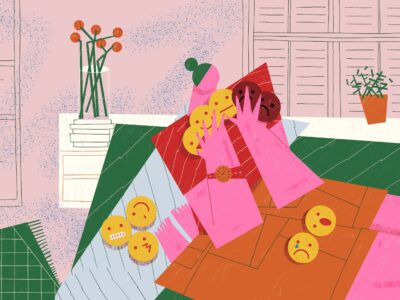 It’s common to wonder whether talking to yourself is “normal.” Let me be the first to tell you—it’s what got me through the pandemic.
 At first, I was reluctant. I asked my body audibly, “How are you feeling?” when my migraines worsened. Often, my body would flood with anxiety or freeze up with stress. When that happened, I’d ask, “What do you need in order to feel more relaxed?” I would wait and listen, then act on what my body “said” back to me. If my body felt tired, I would nap. If I was anxious, I would meditate. If I needed more information about what my body needed, I asked follow-up questions.
 If you’ve ever tried to meditate and found yourself growing restless or struggling to clear your mind, you’re not alone. “It’s the nature of the mind to have this ongoing conversation in the background,” says mindfulness practitioner and author, Joy Rains.
 From murmurations to sunrises, the world around us is breathtaking. We all know what it’s like to be captivated by nature, but did you know that encountering awe is an established element of mindfulness practice?
 Although we may need a break from our thoughts and emotions from time to time, there are also moments when it’s important to both acknowledge and reflect on them. Suzy says: “Meditation can be reflective writing, sitting with our feelings.”
 We all want to feel inner peace. We look for it throughout our entire lives, as being at peace allows us to dream and to actually follow those dreams. When we are at peace with ourselves, we are more understanding and loving towards others, we are able to embody the concept of being One, and therefore we create deeper and more meaningful connections with family, friends and people in general.
 Meditation has been found to have numerous scientific benefits. For example, it reduces stress, improves concentration, boosts creativity, and increases happiness. Meditation affects our mental health in a positive manner, decreasing anxiety and depression, improving sleep, and enhancing self-awareness