People have been fighting over who controls the temperature at home since we lived in caves. Who controls the fire? Who gets to sleep comfortably next to its burning embers on cold nights? Now we call it thermostat wars. One family member likes to crank up the AC in the summer heat, while another is putting on a sweater to be comfortable.
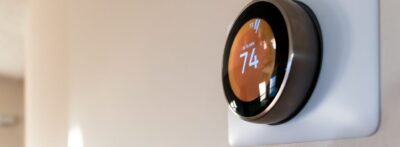
Smart home technology may be the way to end the thermostat wars. Smart thermostats can adjust the temperature room by room, and when someone is in the room or not, lower it temporarily in winter and raise it in summer, making everyone happy while keeping utility bills low.
Smart thermostats can play a role in climate change, too, by responding to peak demand — adjusting to avoid rolling blackouts and overloaded power lines that can start forest fires that take lives and property. Individual choices, house by house, make all the difference.
Our solutions to heating and cooling our homes have evolved with technology. It’s been a bumpy ride. In 2007, the Department of Energy’s extremely successful Energy Star program stopped certifying programmable thermostats—because almost no one used them consistently, and, therefore, they weren’t saving energy. Besides the energy nerds, homeowners found the thermostats too complicated to manage. It was easier to do things the old fashioned way—by changing thermostat settings during the day as needed for comfort.
In that same year, a whole new generation of smart thermostats appeared on the scene when Ecobee debuted what they called the “first smart Wi-Fi thermostat.” Nest soon followed with their own entry into the smart thermostat market. Unlike programmable thermostats, which simply allow you to schedule temperature settings throughout the days, Ecobee and Nest use artificial intelligence to figure out how to keep your home comfortable while reducing your electricity bill.
Smart thermostats can learn your day-to-day patterns and adjust the temperature for both comfort and efficiency. For example, you could set the old programmable thermostats to turn the air conditioning on and off based on time of day, such as when you are at work or late at night. The new ones add occupancy sensors to the toolbox. If you work from home one day a week or someone is staying home from school, you needn’t change all the programming, or override the system. It will happen automatically to keep you comfortable and your home efficient. Smart systems also allow slow or fast ramping up or ramping down temperatures, so that in an emergency your utility can raise your air conditioning setting in a way you won’t notice.
Beyond the Thermostat Wars
We’ve come a long way and now have programmable, communicating thermostats that connect wirelessly to phones and computers and utilities and allow remote access and control.
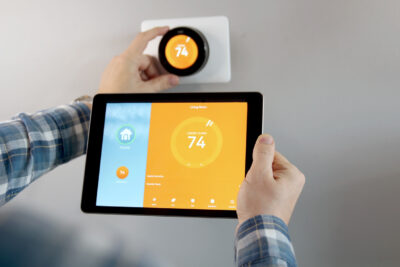 Some utilities now offer incentives to customers in exchange for the ability to control the smart thermostat when power demand is high. The utility’s control is often minimal and customers can typically override the utility setting, but a utility in Colorado recently locked thousands of customer thermostats during an “energy emergency.” If you enroll in this kind of program, be sure you understand what you may give up as a participant.
There are a few ways that working with the utility can be a win for consumers. Many utilities offer time-of-use pricing, so that electricity is cheaper at night when there is lower demand and more expensive during peak demand periods in the late afternoon and early evening. A smart thermostat can minimize your electricity use during peak demand times automatically. The rewards are lower energy bills for you, the customer, without much sacrifice of comfort.
Another way to save money during peak events is by enrolling in programs through companies that partner with utilities, like EnergyHub or OhmConnect.
So what does the utility get out of this arrangement? Quite a bit. Here are a few benefits for utilities:
- The utility’s service area will not experience as many blackouts. This goes a long way in keeping customers happy and perhaps avoiding some litigation over spoiled food and such.
- If the utility is better able to handle peak load, it will minimize the use of expensive, dirty, coal fired “peaker plants.” These are power plants that are in reserve for emergencies. They are expensive to start up and operate, and they put out a lot of CO2, NO2 and other harmful pollutants.
- By automatically shifting energy use in consumer’s homes, utilities may be able to help homeowners avoid costly upgrades to their electrical systems.
But all of these changes bring up another problem. Now that your thermostat can connect to your utility, who can see your home data? In our new connected lifestyles, can you trust your thermostat to utility program staff?
To address these issues, some states have taken steps to protect consumer privacy in the smart grid era. California, Colorado and Virginia guard against improper third party acquisition of your data for commercial purposes, such as targeted advertising. The California Consumer Privacy Act (CCPA) grants strong privacy rights, including allowing a consumer to opt out of the sale of her information to third parties, and to request that a business delete her information from its records.
Trust between utilities and their customers must be based on transparency about how energy use data is collected and stored. As the smart grid evolves, the utility industry will need to update their privacy rules to keep pace, making sure that customers always maintain control over their own data.
About the Author

Jim Gunshinan is a versatile and experienced writer and editor of nonfiction and creative nonfiction works. He writes in a conversational tone and, as a published poet, can paint pictures with words that connect and inspire. Jim blogs about, and has published articles about green homebuilding and renovation, energy, the environment, and climate change. He has also published articles on science and spirituality, personal essays, and poetry.


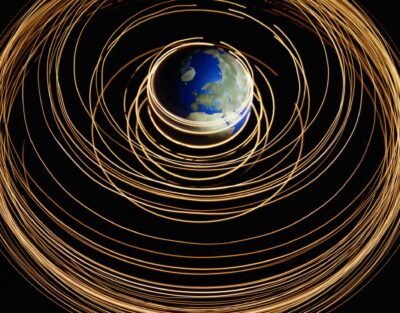 Atomic clocks, combined with precise astronomical measurements, have revealed that the length of a day is suddenly getting longer, and scientists don’t know why.
 A comparison between these estimates and an atomic clock has revealed a seemingly ever-shortening length of day over the past few years.
 The sky was a classic California cloudless blue. The light, February soft. The sea breeze, easy, fragrant, and chilly. The waves, mellow laps against the rocky arch at the Natural Bridges State Marine Reserve, about 75 miles south of San Francisco.
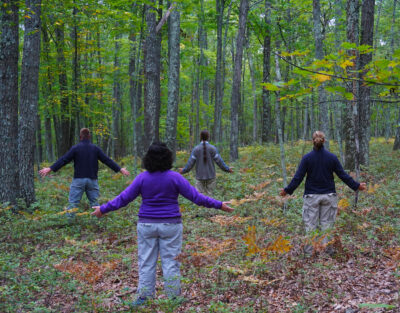 Doing it before school or work would be a beautifully irreverent and rebellious thing to do: to remind yourself that this is our most important work as human beings, rather than something that is done after our jobs or homework or housework are complete, and only then if we are not yet completely weighed down by exhaustion.
 The good life is the simple life. Among philosophical ideas about how we should live, this one is a hardy perennial; from Socrates to Thoreau, from the Buddha to Wendell Berry, thinkers have been peddling it for more than two millennia. And it still has plenty of adherents. Magazines such as Real Simple call out to us from the supermarket checkout; Oprah Winfrey regularly interviews fans of simple living such as Jack Kornfield, a teacher of Buddhist mindfulness; the Slow Movement, which advocates a return to pre-industrial basics, attracts followers across continents.
 Somewhat paradoxically, then, the case for living simply was most persuasive when most people had little choice but to live that way. The traditional arguments for simple living in effect rationalise a necessity. But the same arguments have less purchase when the life of frugal simplicity is a choice, one way of living among many. Then the philosophy of frugality becomes a hard sell.

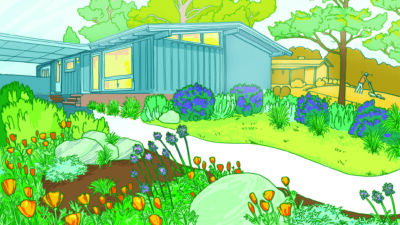
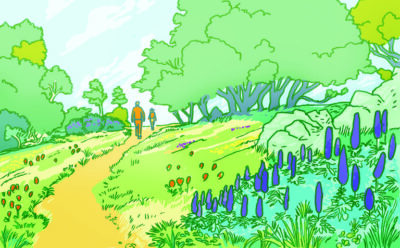 The great likelihood is that you’re going to be adapting to the conditions you already have. Those conditions might not appear to be “optimal” in the traditional horticultural sense. But plants grow in the wild without fertilizer. Survivors adapt, learning to love even marginal soil. They also forge relationships with other plants, animals, and the microbiology of the soil. These relationships become the foundation of a sustainable and resilient landscape.
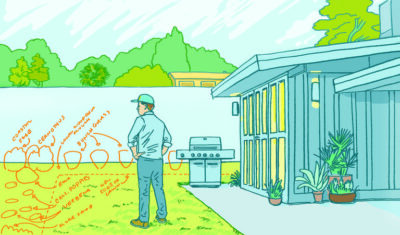 Now that you’ve observed, ask…What plants will thrive in my yard? In other words, what does nature want? And what do I want? Where these desires meet will be the foundation of your design.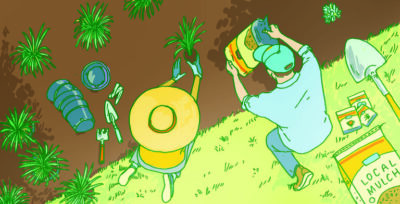
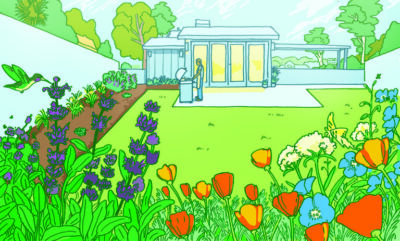 Watch how the landscape evolves. “Don’t be discouraged if some of the plants in your palette don’t do well, even though you did the research,” says Max Kanter, cofounder of Saturate, an ecologically minded gardening company in Los Angeles. Some might not be placed quite right, while others will thrive in ways you didn’t expect. “Start to practice the idea that the garden is a process,” he says. It’s not an installation or a transaction; it’s a relationship.