

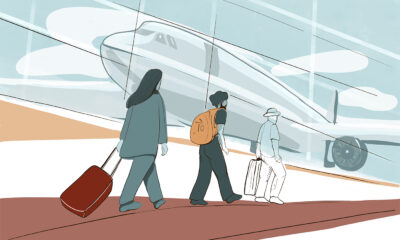
When Amrita Chavan boarded her plane in Mumbai, India, grief was the last thing on her mind. This was a new beginning. She was 19, bound for Canada, the first of her family to go abroad to pursue higher education. The goodbye was heartbreaking, she recalls; all of her relatives came to the airport for the send-off. But at the time, it was difficult for Chavan and her family to fully grasp the sacrifice she was making. “We had no idea what it meant to leave home,” she says.
Then, inevitably, grief came knocking. Almost 12 years after Chavan’s departure, while she was sitting in her apartment in Winnipeg in early 2020, Chavan’s stomach dropped as her mom called with the news. Chavan’s grandmother, who lived in Sydney, Australia, had fallen sick, and over the course of a few weeks, had passed away. There was no way she could go to mourn in person for her grandmother, one of the most important people in her life. Flights to Australia were expensive, and she couldn’t afford to apply for the visa she would need to even get into the country. So instead, Chavan emotionally shut down. “I felt very frozen for a very long time,” she says.
Migrant researchers and psychologists call what Chavan was experiencing transnational grief, or transnational bereavement. It refers to the unique experience of losing someone you love while in another country. Although grief is already a difficult process, immigrants who experience transnational grief often go through additional layers of guilt, denial, and suffering since they are unable to attend the typical rituals associated with loss.
I did not feel like I had permission to grieve, because I had not been there.”
The inability to see their loved one in person makes it difficult to achieve closure, and the bereaved may be unable to process the loss and move forward. In recent years, this reality has become more apparent, as COVID-19 claimed millions of lives while simultaneously forcing border restrictions. The pandemic further highlighted the critical role of community support and immigration policy shifts to help those who grieve from afar.
The Toll of Long-Distance Loss
Experiencing grief from a distance has long been the reality of immigrants. Anyone who leaves their family behind also risks being apart from their loved ones during times of loss—and often this grief comes with a whirlwind of complicated emotions.
“There is a strong sense of guilt. There is a strong sense of regret that they weren’t able to be with their loved one as the loved one died,” says Zohreh Bayatrizi, a grief researcher at the University of Alberta. She recalls a conversation she had when she interviewed an Iranian-Canadian immigrant who had lost their brother during the lockdowns in the COVID pandemic. Because they were unable to travel back home, or even see his body before it was buried, they refused to accept that their brother’s death was real.
Chavan recalls similar experiences, being separated by borders. “I did not feel like I had permission to grieve, because I had not been there,” she says.
Without this space to mourn, grief can become difficult to move past—especially for immigrants who are undocumented. Kristina Fullerton Rico, a sociologist at the University of Michigan’s Center of Racial Justice, works with these communities, and continuously hears about how grief affects everyday lives. “People described these experiences of grief and long-distance mourning as one of the most difficult parts of being undocumented in the United States,” she says.
For instance, while studying this phenomenon between 2017 and 2023, Fullerton Rico met a woman whom she calls Florencia (a pseudonym used to protect her privacy) who said, “When you experience grief [as an immigrant], your only option is to accept that you can’t do anything.” Fullerton Rico also shares a conversation she had with a man she calls Felipe: “Felipe told me grief changes you deeply.” The depth of that grief is exacerbated by distance when you can’t get closure from saying goodbye or attending a funeral, he told her. “It’s a chapter with no ending, and it remains unfinished.”
To make matters worse, the weight of transnational grief often remains a burden borne alone. “It isn’t something that people usually talk about,” Fullerton Rico says.
Bridging the Distance
Social rituals, in any culture, are an important part of the grieving process. Wakes and other celebrations of life can help people actively engage with memories of an individual, says Zoe Donaldson, a neuroscientist who studies grief at the University of Colorado Boulder. “Thinking of these memories allows your brain to sort of remodel and think about how these memories now fit into your life,” she says. But for those who don’t witness deaths or funerals in person, this process may be disrupted or made more difficult.
They had to sneak away to the bathroom, or hide in a walk-in refrigerator to get glimpses of one of the most significant rituals in somebody’s life.”
Gabriela Encina, a psychologist who works with expats, helps clients construct their own rituals so that they can celebrate their relationship with their loved one. She walks them through the process of grieving from afar, through actions like letter-writing, eating a loved one’s favorite meal, or participating in a favorite shared activity. The process takes time. Several sessions of goodbyes and rituals are often necessary for someone to make peace with a sudden death, says Encina.
Similarly, during the pandemic, Chavan found her own turning point for bereavement in creative nonfiction. She had lost her job at the time and decided to attend a writing class, taking on a project that allowed her to dive into her experiences with transnational grief. Through the process of writing, Chavan slowly broke the ice that had encased her for eight months. She sobbed as she remembered all the details about her grandmother: the spirited debates they would get into, how she commanded a room despite her small size, how she brought the family together with her love.
“It was awful. It was devastating. It felt like losing her all over again,” Chavan says.
But it was this act of writing and remembrance that allowed her to reconnect to her memories—and start to heal.
Systemic Solutions
Ultimately, making space for transnational grief requires the restructuring of how we think about immigration and loss. Currently, it takes years for an undocumented immigrant to become a legal, permanent resident in the U.S., and the few who are able to adjust their immigration status typically receive work authorization before the ability to travel back home, Fullerton Rico says. And so the opportunity of visiting loved ones becomes a waiting game, even as family members age or pass away.
“If we pass laws that prioritize a fast path to citizenship, we could avoid having people go through these experiences,” Fullerton Rico says.
Many undocumented immigrants also have inflexible, low-wage jobs, which pressures them to make painful decisions, like watching their loved ones’ funeral on a smartphone in between helping customers or preparing meals at a restaurant. “Instead of being there in person, they had to sneak away to the bathroom, or hide in a walk-in refrigerator to get glimpses of one of the most significant rituals in somebody’s life,” Fullerton Rico says.
Giving time and space for a person to grieve in the form of paid bereavement leave can help. This allows grievers to take time off work without facing the potential consequences of losing a paycheck or their job. Chavan recalls the pressure to continue to work in the midst of her grief because she didn’t have the financial flexibility to lose out on paid hourly work, which gradually degraded her mental health. Currently, only five states in the U.S. mandate employers to give bereavement leave, Fullerton Rico says, only two of which require the leave to be paid.
Most importantly, it’s crucial to “let people know that they’re not alone in this pain,” Fullerton Rico says. She urges more immigrant-serving organizations to recognize this reality and help immigrants get access to counseling, other mental health resources, or religious rituals so they’re less at risk of conditions like clinical depression. She shares the example of a Catholic priest she interviewed in New York City, who has helped perform memorial Masses for transnational mourners since the 1990s. Today, these funeral ceremonies are held and streamed through Facebook Live, YouTube, or Zoom, helping families feel some sense of togetherness.
Experts agree that forming this social support is a key factor in the grieving process. “Grief is something of a social experience,” Bayatrizi says. “It’s an emotional experience that’s shaped through our social interactions.”
Chavan says that the only reason she finally felt ready to face the emotions was because her partner and her in-laws were supportive, giving her a small but strong community in an isolating time. After writing about the experience, she also started having more conversations with family and friends who had read the article, about the struggle of grieving from afar and how they coped.
“It meant that I had this community, this global community that I could reach out to essentially,” she says. “Learning that you are not alone in something that you have gone through can be very powerful.”
Original article here

 World Journey stories teach us to overcome adversity, but more importantly, they teach us how to experience adversity in the first place. Successful myths, religious texts, and fairy tales — and modern screenplay and film — do not skirt the issue of hardship and conflict, nor do they encourage us to finish the hard work as quickly as possible. The characters in J.K. Rowling’s Harry Potter do not face obstacles and beasts simply to advance the plot, but to develop the inner courage and tenacity needed to grow as individuals within society. Mythic stories put us squarely in the middle of the hardest tasks we can imagine, and they force us to work hard, to guess, to take leaps of faith, and to test ourselves to the limit.

 Hindmarch is not the first writer to wax lyrical about shampoo as therapy. I first discovered this life philosophy in the oeuvre of that national treasure of sunlounger fiction, Jilly Cooper. When a Cooper heroine is having a bad day – perhaps her lover is a double-crossing bastard, or the roof of the conservatory is falling in – she doesn’t crawl back to bed. She washes her hair, knocks back a stiff drink and cracks on. The scent of freshly washed hair is always a harbinger of good news in Cooper’s world. And she was on to something, because how you shampoo your hair might matter more than how you style it. “The mistake most people are making is using products that are too rich, and letting them build up,” says Northwood. “Healthy hair starts with getting it properly clean.” A professional will always wash your hair twice, because the first shampoo loosens the dirt, while the rinse-and-repeat gets it really clean.





 This makes such feelings doubly unwelcome. Most of us can tolerate negative emotions if we see them as instrumental to something desirable—we do not run to a therapist to treat a fear if we think that it holds us back from doing something obviously risky. But unlike fear, what Heidegger calls anxiety and what Heid’s article describes do not protect us from anything specific. No wonder why Sigmund Freud called anxiety a “riddle.”




 LalalaLetMeExplain is an anonymous relationships expert and social worker, and the author of Block, Delete, Move On, a book she describes as not trying to teach anybody how to find love but “how to avoid the toxic ones”. The book was inspired by her own struggles to set boundaries in the era of dating apps.