
The 17th century philosopher Blaise Pascal is perhaps best known for Pascal’s Wager which, in the first formal use of decision theory, argued that believing in God is the most pragmatic decision. But it seems the French thinker also had a knack for psychology. As Brain Pickings points out, Pascal set out the most effective way to get someone to change their mind, centuries before experimental psychologists began to formally study persuasion:
When we wish to correct with advantage, and to show another that he errs, we must notice from what side he views the matter, for on that side it is usually true, and admit that truth to him, but reveal to him the side on which it is false. He is satisfied with that, for he sees that he was not mistaken, and that he only failed to see all sides. Now, no one is offended at not seeing everything; but one does not like to be mistaken, and that perhaps arises from the fact that man naturally cannot see everything, and that naturally he cannot err in the side he looks at, since the perceptions of our senses are always true.
People are generally better persuaded by the reasons which they have themselves discovered than by those which have come into the mind of others.
Put simply, Pascal suggests that before disagreeing with someone, first point out the ways in which they’re right. And to effectively persuade someone to change their mind, lead them to discover a counter-point of their own accord. Arthur Markman, psychology professor at The University of Texas at Austin, says both these points hold true.
“One of the first things you have to do to give someone permission to change their mind is to lower their defenses and prevent them from digging their heels in to the position they already staked out,” he says. “If I immediately start to tell you all the ways in which you’re wrong, there’s no incentive for you to co-operate. But if I start by saying, ‘Ah yeah, you made a couple of really good points here, I think these are important issues,’ now you’re giving the other party a reason to want to co-operate as part of the exchange. And that gives you a chance to give voice your own concerns about their position in a way that allows co-operation.”
Markman also supports Pascal’s second persuasive suggestion. “If I have an idea myself, I feel I can claim ownership over that idea, as opposed to having to take your idea, which means I have to explicitly say, ‘I’m going to defer to you as the authority on this.’ Not everybody wants to do that,” he adds.
In other words, if it wasn’t enough that Pascal is recognized as a mathematician, physicist, and philosopher, it seems he was also an early psychologist.
Original article here
 Of course, this is ridiculous. You cannot easily force yourself to forget something or someone. In fact, the more you try, the harder it becomes. But you can stop yourself from reliving those memories. This is what lies at the heart of this week’s question. When something bad happens to you — something traumatic, even — how far should we try to move on and how far should we try to unpack our past? I do not have a psychology degree, and I am not a psychotherapist, so I will approach this from a philosophical point of view and ask: How important is our past to our future? Should Kant try to forget Lampe or carry his memory as part of him? Should Dee let go of the past or dig it up and face it down?


 World Journey stories teach us to overcome adversity, but more importantly, they teach us how to experience adversity in the first place. Successful myths, religious texts, and fairy tales — and modern screenplay and film — do not skirt the issue of hardship and conflict, nor do they encourage us to finish the hard work as quickly as possible. The characters in J.K. Rowling’s Harry Potter do not face obstacles and beasts simply to advance the plot, but to develop the inner courage and tenacity needed to grow as individuals within society. Mythic stories put us squarely in the middle of the hardest tasks we can imagine, and they force us to work hard, to guess, to take leaps of faith, and to test ourselves to the limit.


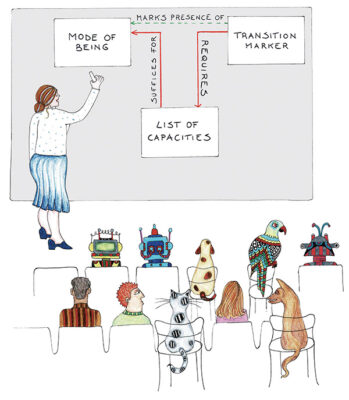 A consensus list of consciousness capacities is a step forward, but identifying each and every capacity may be difficult, and a list does not tell us how they interact to form a conscious being. If we could find a single system-property — an evolutionary marker of consciousness — that indicates that the organism has evolved all the capacities in the consensus list, we would be in a much better position. Finding such a single, diagnostic transition marker would make it possible to identify the simplest evolved conscious being, reconstruct the processes and structures that underlie it, and figure out how they interact. If we can follow the evolution of the marker and therefore the evolution of consciousness, we can discover when and how the conscious mode of being originated.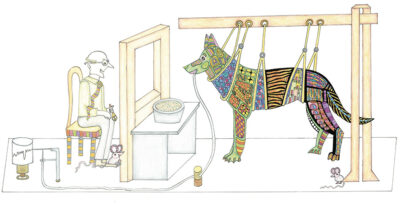
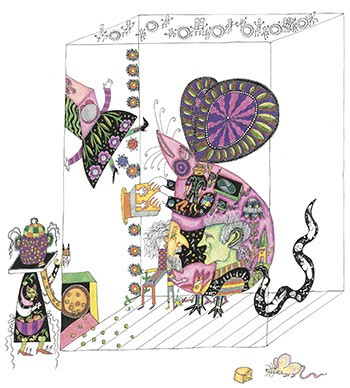 The study of associative learning today includes the investigation of the underlying cognitive and neurobiological mechanisms in ecologically relevant conditions such as the social conditions in which animals learn from each other. It is a rich and productive research program, which is no longer constrained by the behaviorists’ maxims. There is an irony in our (qualified) return to the 19th-century suggestion that open-ended associative learning is an evolutionary transition marker of consciousness, the very term that behaviorists tried to purge from psychology.
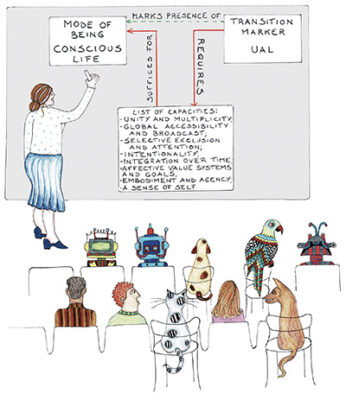 (i) It can distinguish between novel complex patterns of stimuli and actions. For example, it can learn to navigate in a new terrain — to discriminate between different types of animals, between different routes leading to food and shelter. The learned patterns are genuinely novel: they are not reflex-eliciting patterns, nor have they been learned in the past.
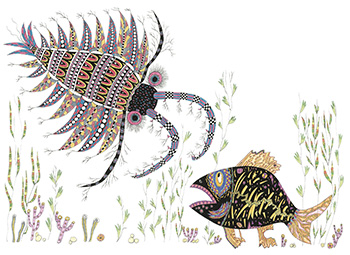 Animals that could mitigate the high costs of UAL without giving up its benefits would have a great advantage. The evolutionary elaboration of the ubiquitous stress response and the evolution of active forgetting are some of the ameliorating mechanisms that we expect to find in all associatively learning animals, and in particular, in UAL animals. Suffering was not eliminated, but it became more controlled.