

If ‘more sleep’ or ‘less stress’ are goals for you, then you’ll probably have tried to introduce a few changes to your routine. You’ve hung blackout curtains, tried to finish dinner by 8pm and stopped scrolling on TikTok in the evenings. And yet, here you are, still feeling tired. Maybe that’s because you’re missing one crucial stress-busting element: the vagus nerve.
“The vagus nerve is responsible for a huge number of signals from the digestive system and organs to the brain and vice versa,” says Dr Deepak Ravindran, author of The Pain-Free Mindset. “It’s an important part of the parasympathetic system, the so-called ‘rest and digest’ part of the nervous system.
“While the sympathetic system is responsible for the ‘fight and flight’ aspect, we need the parasympathetic system in full readiness to support us when needed.”
You can engage this system through vagus nerve stimulation – non-interventional exercises that help improve the tone of the nerve. Dr Ravindran explains: “Vagal tone is an internal biological process that represents the activity of the nerve. Increasing your vagal tone activates the parasympathetic nervous system. Therefore, having a higher baseline vagal tone can allow the body to relax faster after stress.”
So, tone up your vagus nerve and you’ll be mentally and physically fitter to deal with stressful situations. The good news is that there’s a wealth of quick and easy DIY ways to achieve this – from yoga to massage and singing to cold exposure. Here’s what the experts recommend.
Hum, sing and vibrate for more calm
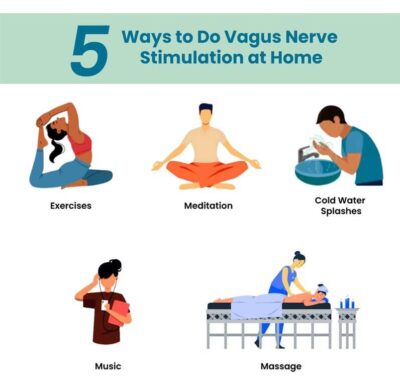 Singing, humming, chanting and even gargling can improve vagal tone because the vagus nerve controls your vocal cords and the muscles at the back of your throat, explains Dr Ravindran. A brain imaging study even found that the humming involved in the meditation chant ‘om’ reduced activity in areas of the brain associated with depression.
That might mean humming your favourite tunes or taking time out to head to a yin yoga class that usually finishes with a spot of class chanting. Yoga instructor Scarlett Woodford tells Strong Women: “When you have a whole room of people chanting it can feel incredibly vibrational and healing.
“However, if this feels a bit overwhelming, the simple chant of ‘om’ on your own is perfect. Try to make each ‘om’ last as long as your natural exhale, with equal parts on both the ‘O’ with an open mouth and ‘M’ with a closed mouth.”
Alternatively, get your cat to do the heavy lifting by sitting on your chest. Not only is a purring cat an immediate comforter, but the furry little things have been proven to stimulate the vagus nerve. Petting your cat for just 10 minutes has been scientifically proven to reduce levels of the stress hormone cortisol, so we all win (well, the cat lovers do).
Give restorative yoga a go
Dr Ravindran recommends exercise, particularly yoga, for improving vagal tone. Yogi and founder of The Yoga Class Laura Dodd finds restorative yoga postures such as supported fish pose or legs up the wall are her go-to moves after a stressful day.
“They truly help me switch off my mind and find a deep state of relaxation,” she says. “As well as stimulating the vagus nerve, the heart-opening nature of these poses helps promote deeper, more effective breathing and relief for upper back and neck tension.”
How to do a supported fish pose (matsyasana)
- Unlike full fish pose, this gentle backbend uses props to promote relaxation. You may wish to use a block under the head, one positioned between the shoulder blades or just a bolster down the length of the spine.
- Lie down on your props with your legs straight and arms relaxed by your sides.
- Feel an opening in the upper chest area and come to a slow, deep belly breath for at least five minutes.
Try applying acupressure to your ear
From massage to hugs, touch is believed to help stimulate the vagus nerve. Manipulating specific acupressure points, however, is thought to have the most profound effect.
“I often suggest massage points to my patients to help them stimulate the vagus nerve and restore calm in their daily lives,” says acupuncturist Saffron Pretty. “My favourites include the ear point ‘shen men’ found in the upper third of the ear just within the shaded part.
“Ideally, this area is best stimulated with firm pressure and an even circular motion using a finger or rounded object while seated or lying down. You can do this several times a day or when going off to sleep at night with attention on the breath to aid relaxation.”
Give breathwork a go
It’s no surprise that slow, deep breathing helps us relax, but a study by the National Yang-Ming University in Taiwan specifically found that slow-paced breathing enhances vagal activity and improves sleep quality in insomniacs.
If you find it hard to maintain steady, controlled breathing, another smart gadget is available. The Moonbird (£159) sits comfortably in your hand and guides your breathing. Once activated, the Moonbird comes to life slowly expanding and shrinking like a little lung (in a cute way – not a macabre one) encouraging you to breathe in and out in time with the movement.
When used with the app, you can breathe to a soundtrack of relaxing sounds while it gives real-time feedback on your body’s response. A plus point is that you can use it without the app so it’s perfect for holding in bed as you drift off to sleep but want to maintain a phone-free zone.
Ice your vagus nerve with cold water
“Exposure to cold activates the vagus nerve and lowers the ‘fight or flight’ response,” says Dr Ravindran. “ Cold water swimming is one option but you can simply turn your taps to cold at the end of your morning shower for 30-60 seconds or splash your face in ice cold water two or three times a day.”
Over on that hotbed of wellness hacks TikTok, the #VagusNervehashtag has chalked up over 175 million views. Ever since TikToker Frankie Simmons shared her experience of achieving an instant solution to insomnia after ‘freezing’ her vagus nerve, the ‘vagus nerve icing’ trend has had us raiding the freezer for the key to calm.
How to ice your vagus nerve:
- Wrap an ice pack or bag of frozen peas in a towel.
- Lie down and place the cold bundle in the middle of your chest.
- Relax in this position for 15 minutes or as long as needed. Blissful sleep awaits…
Original article here




 The Cambridge Brain Sciences 12-point online test covers a wide application of cognitive abilities, including spatial working memory, reasoning, planning, cognitive flexibility, and visuospatial working memory. A total of 10,886 participants, including 6,796 women and 4,013 men (average age of 41.7 years), were assessed. The optimal amount of sleep for reasoning, verbal, and overall abilities, turned out to be 7.16 hours.


 The late actor Chadwick Boseman found calm in the sound of a djembe drum, said Viola Davis in an interview with USA Today. “One of the things that he carried everywhere was his djembe drum, which is called a talking drum in Africa. And he carried it himself,” Davis remembered about her Ma Rainey’s Black Bottom co-star: “He said ‘Viola, wherever I go, I carry my djembe drum. I do it for me. I play this drum for me, for my healing.’ It felt like he was playing that for God, for himself. There are no words to describe the playing because I love the djembe drum, but listening to him play when he had breaks in that trailer was just phenomenal.”
 Carving out time for mindfulness often feels like an indulgence, but it’s necessary. And unlike everything else on your to-do list, there are simple ways to pause and reset—like the 4-7-8 breathing technique. A controlled breathing pattern intended to help the mind and body relax, the 4-7-8 technique has helped many transition from a stressful storm into a more focused, present self.
 You might think that the impact of aging on the brain is something you can’t do much about. After all, isn’t it an inevitability?
 For 30 years Isabelle Arnulf, head of the sleep disorders clinic at Pitié-Salpêtrière Hospital in Paris, has studied sleep and its associated disorders. During her career, Arnulf, who is also a professor of neurology at Sorbonne University in France, has researched a broad range of sleep conditions: sleepwalking, rapid eye movement (REM) sleep behavior disorder, lucid dreaming, sleep in Parkinson’s disease and hypersomnia, or excessive daytime sleepiness. As part of these studies, Arnulf investigated how these disorders affect dream states. In an interview with Scientific American’s French-language sister publication Pour la Science, the neurologist talks about whether depression or trauma affects dreaming and whether one should worry about recurring nightmares.
 In depression, dreams are very negative, mirroring the mental state of depressed people during the day. This parallel was brought to light in the early 2000s by researcher Dieter Riemann and his colleagues at the University of Freiburg in Germany. By analyzing the dreams of depressed patients treated with antidepressants, they discovered that as the treatment began to take effect after several weeks, the content of these dreams became less and less gloomy, and the mood of the patients improved.
 For a long time, we approached recurring nightmares through the prism of psychoanalysis, [which explained them as] unresolved trauma that we would have to work to resolve. But the fact is: we don’t know.
 Not getting enough sleep is detrimental to both your health and productivity. Yawn. We’ve heard it all before. But results from one study impress just how bad a cumulative lack of sleep can be on performance. Subjects in a lab-based sleep study who were allowed to get only six hours of sleep a night for two weeks straight functioned as poorly as those who were forced to stay awake for two days straight. The kicker is the people who slept six hours per night thought they were doing just fine.
 If you think you sleep seven hours a night, as one out of every three Americans does, it’s entirely possible you’re only getting six.
 There are a number of different factors in your day-to-day life that can make it difficult to get to sleep, from stress to our central heating. People are reporting sleep disturbances more than ever: the average person is losing two hours of sleep a night and 37% of people in Britain are sleep deprived, according to 2021 research from fitness tech brand Zepp.
 Some ingredients may not always be a good idea to eat close to bedtime due to their energising nature. Both Brielle and Dr Iqbal particularly warn against the consumption of caffeine too late in the day, “because it stimulates the brain and gives you energy, thus keeping you awake”, says Brielle.