 The tantalising theory that a fifth force of nature could exist has been given a boost thanks to unexpected wobbling by a subatomic particle, physicists have revealed.
According to current understanding, there are four fundamental forces in nature, three of which – the electromagnetic force and the strong and weak nuclear forces – are explained by the standard model of particle physics.
However, the model does not explain the other known fundamental force, gravity, or dark matter – a strange and mysterious substance thought to make up about 27% of the universe.
Now researchers have said there could be another, fifth, fundamental force of nature.
Dr Mitesh Patel, from Imperial College London, said: “We’re talking about a fifth force because we can’t necessarily explain the behaviour [in these experiments] with the four we know about.”
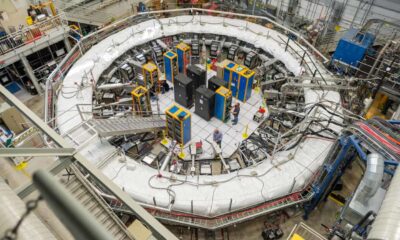
The data comes from experiments at the Fermilab US particle accelerator facility, which explored how subatomic particles called muons – similar to electrons but about 200 times heavier – move in a magnetic field.
Patel says the muons behave a bit like a child’s spinning top, in rotating around the axis of the magnetic field. However, as the muons move, they wobble. The frequency of that wobble can be predicted by the standard model.
But the experimental results from FermiLab do not appear to match those predictions.
Prof Jon Butterworth of University College London, who works on the Atlas experiment at the Large Hadron Collider (LHC) at Cern, said: “The wobbles are due to the way the muon interacts with a magnetic field. They can be calculated very precisely in the standard model but that calculation involves quantum loops, with known particles appearing in those loops.
“If the measurements don’t line up with the prediction, that could be a sign that there is some unknown particle appearing in the loops – which could, for example, be the carrier of a fifth force.”
The findings follow previous work from FermiLab that showed similar results.
But Patel said there was a “fly in the ointment”, noting that between the first results and the new data, uncertainty has increased around the theoretical prediction of the frequency.
That, he said, could shift the situation. “Maybe what they are seeing is standard scientific thinking – the so-called standard model,” Patel said.
There are other issues. Butterworth said: “If the discrepancy is confirmed, we will be sure there is something new and exciting but we won’t be sure exactly what it is.
“Ideally the discrepancy would inform new theoretical ideas that would lead to new predictions – for example, of how we might find the particle that carries the new force, if that’s what it is. The final confirmation would then be building an experiment to directly discover that particle.”
The experiments at Fermilab are not the only ones to suggest the possibility of a fifth force: work at the LHC has also produced tantalising findings, albeit with a different type of experiment looking at the rate at which muons and electrons are produced as certain particles decay.
But Patel, who worked on the LHC experiments, said those results were now less coherent.
“They are different experiments, measuring different things, and there may or may not be a connection,” he said.
Butterworth added that the unexpected frequency of the muons’ wobbles was one of the longest-standing and most significant discrepancies between a measurement and the standard model.
“The measurement is a great achievement, and very unlikely to be in error now,” he said. “So if the theory predictions get sorted out, this could indeed be the first confirmed evidence for a fifth force – or something else strange and beyond the standard model.”
Original article here
 You might think that after centuries of studying light, we know pretty much everything about it. It’s true we’ve had breakthrough after breakthrough in using it, from illumination to communication, from examining the micro- and macro-universes to scanning our own bodies. We understand that light is an electromagnetic wave, thanks to James Clerk Maxwell, whose equations established that in 1865; and that it also appears as quantum packets of electromagnetic energy called photons, as Albert Einstein recognized in 1905. But the more we look into light, the more we see and the more we learn. The classical view of light as a wave still produces new science as light waves interact with artificial “metamaterials”; and we are still exploring light as a quantum particle. Both approaches provide ways to manipulate light that were once only science fiction. Here are five recent marvels.
 In ghost imaging, one of each of a swarm of entangled photon pairs interacts with the object and encounters a detector that simply registers its arrival. A second beam of the corresponding entangled partners never touches the object but goes straight to a sensitive multi-pixel detector. Computer analysis of the correlations between the two detector results creates a high-quality image of the object, even with weak illumination. This approach has uses such as converting images covertly taken by invisible infrared light to visible images detected by a high-resolution camera; or obtaining good quality X-ray images from a patient exposed to a low, relatively safe X-ray dose.
 Time travel makes regular appearances in popular culture, with innumerable time travel storylines in movies, television and literature. But it is a surprisingly old idea: one can argue that the Greek tragedy Oedipus Rex, written by Sophocles over 2,500 years ago, is the first time travel story.
 Kurt Vonnegut’s anti-war novel Slaughterhouse-Five, published in 1969, describes how to evade the grandfather paradox. If free will simply does not exist, it is not possible to kill one’s grandfather in the past, since he was not killed in the past. The novel’s protagonist, Billy Pilgrim, can only travel to other points on his world line (the timeline he exists in), but not to any other point in space-time, so he could not even contemplate killing his grandfather.
 In 1905, the 26-year-old Albert Einstein proposed something quite outrageous: that light could be both wave or particle. This idea is just as weird as it sounds. How could something be two things that are so different? A particle is small and confined to a tiny space, while a wave is something that spreads out. Particles hit one another and scatter about. Waves refract and diffract. They add on or cancel each other out in superpositions. These are very different behaviors.
 Almost any time physicists announce that they’ve discovered a new particle, whether it’s the Higgs boson or the recently bagged double-charm tetraquark, what they’ve actually spotted is a small bump rising from an otherwise smooth curve on a plot. Such a bump is the unmistakable signature of “resonance,” one of the most ubiquitous phenomena in nature.