
 Have you been feeling more fearful lately? Between a lingering pandemic, news of global warming, divisive politics, and beyond, there are plenty of things that spark fear in us these days. And while it doesn’t sound “cool” to admit that, yes, you’ve probably been afraid of something over the past few years, experts stress that fear is a perfectly normal emotion — and one that is even helpful in some situations.
“Our threat response is responsible for keeping us and all species alive,” explains Margee Kerr, a University of Pittsburgh sociologist who studies fear. And sometimes fear can even be a little fun. Kerr has found that activities like riding a roller coaster have benefits. “My colleague and I found that those who chose to go through a haunted house experienced an improvement in mood, which was related to experiencing the attraction as more thrilling, scary, and intense,” she says. And people who challenge fears, like jumping out of a plane when petrified of heights, are likely to feel better about themselves afterward.
It’s normal to turn on the news and get a little revved up. Or to have a conversation about a current event elicit a fear response. But when fear becomes constant, it may be doing more harm than good. “When fear and worry get stuck in the ‘on’ position, it can lead to chronic stress that can affect sleep, weight gain/loss, your immune system, and potentially lead to heart disease,” warns Andrea Dindinger, a licensed marriage and family therapist in San Francisco.
Here are some expert-backed tips on how to live with less fear.
Recognize how your fear is holding you back
“You cannot hang on to the darkness of today if you want to embrace a brighter tomorrow,” says Dr. Cindy Trimm, the author of The Rules of Engagement for Overcoming Your Past: Breaking Free From Guilt, Rejection, Abuse, and Betrayal. The problem with fear, she says, is that it makes you stay in place. “We hide out at home when we should be reaching out and embracing new experiences. We stay in bad relationships when we should be moving on to better ones. We make other people a priority when they have made us an option,” explains Trimm.
Talk it out
“None of us are meant to do it all by ourselves,” says Paul Conti, MD, the author of Trauma: The Invisible Epidemic: How Trauma Works and How We Can Heal From It. “When fear begins to take its toll, reach out to family members, friends, and any mental-health care services or other organizations in your community that you trust.”
Just like therapists who specialize in marriage and family therapy, there are experts who can help you tackle fears, phobias, PTSD, and other anxieties. “Treatment modalities include everything from cognitive behavioral therapy to a variety of medications, exposure therapy, and lifestyle adjustments,” says Kerr.
Reduce your exposure
“It’s easy to stoke the fires of fear; it’s a lot harder to put them out when they’re raging,” says Conti. Know your limits when it comes to media exposure, stressful conversations, and negative thought patterns. And don’t be afraid to set boundaries for yourself and with others. If you have a friend who only wants to talk about the pandemic, and you feel yourself needing a breather, be honest. Ask if she wouldn’t mind changing the subject to something more uplifting instead, like the latest show you both watched.
Be curious
Take small steps toward facing your fears. “Continuing to find ways to challenge oneself that involve pushing boundaries can help a person learn about themselves and gain a sense of confidence in their abilities (physical and mental), which in turn can work toward improving skills of resilience,” Kerr explains. And that resilience can help you become better equipped to cope with turbulent times. So, if you’re afraid of dogs, don’t force yourself to run up and pet one. But maybe try stepping into a park where a dog is a mile away, on a leash, and sit with that feeling. Move up from there.
Have compassion for yourself
 Nicole Catenazzi, a life coach and the creator of the Fearless Heart Method for Living Bravely, challenges people to examine their fears with compassion. Ask yourself questions like “What is this fear protecting me from?” and “What is this fear preventing me from?” “This can help you decipher whether your fear serves you or constrains you,” she explains. Once you understand fear’s effects, you may become more apt to challenge it. And go easy on yourself. Everyone deals with fear in some capacity — from humans to chimpanzees and even insects!
Focus on what you can control; surrender to what you can’t
While you can’t control everything, Dr. Therese Rosenblatt, a psychologist in private practice in New York, says there are steps you can take to mitigate parts of your fears. “Say you have a fear of Covid. What you can do with that fear is to face it long enough to make a plan to do whatever we can to minimize the risk of contracting it and to minimize the severity if you do get ill,” she said. Thus, she challenges people to direct their energies to things they can control, like getting a vaccine, following mask guidelines, eating and sleeping well, and avoiding large crowds. “Beyond that, we must accept the parts we cannot control, to live one day at a time, and to be present in the moment,” she said.
Identify the difference between real fear and perceived fear
Real fear, says Shirin Eskandani, a Brooklyn-based life coach, is the type of fear we have before going down a dark alley. Perceived fear, on the other hand, is what we most often experience day to day with our worries about the future and stresses in our lives. “A great way to figure out which is which is to get clear on what each fear feels like in your body, and what thoughts you have when you’re in the two different states,” she explains.
Try breathing in on a count of four and taking a four-count breath out. “This allows us to create a little bit of space between our worry and reality so you can figure out whether what you’re scared of is real or perceived — because so often at the mere sign of fear, we go into fight, flight, freeze, or faint,” Eskandani adds.
Put your fear on trial
When you feel afraid, tune in to what you’re thinking. Examine those thoughts and, as Jose Ramirez, a licensed mental-health counselor in Fort Lauderdale, suggests, put them on trial. “Look at the evidence to determine whether there is some truth to them or if it’s mainly unhelpful thinking,” he suggests. If the fear is rooted in truth, then there may be something you can do to improve them. But if you realize it’s just unhelpful thinking, Ramirez says this awareness can help quiet them down.
Practice grounding yourself
If you’re hit with an overwhelming surge of fear, do something to ground yourself. “Often taught to people who experience PTSD or dissociation, grounding can help you snap out of your head and into your body,” says Ramirez. Try this simple technique: Use your senses. Notice a few things you can see, taste, hear, feel, and smell. Really dive deep, and let the things you are noticing take over. “This will bring your awareness to your body and your physical surroundings and help you get out of your head a bit,” Ramirez explains.
Original article here
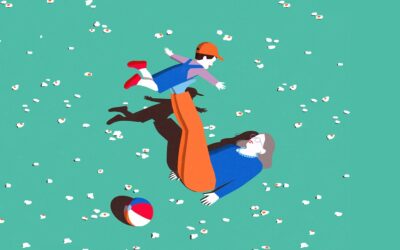 Pandemic life had a way of revealing our weaknesses. For those of us of a certain age, I mean that literally. If you are feeling like certain household activities — toting groceries, hoisting children, moving furniture, carrying laundry — are more difficult than they were in the past, you aren’t alone. And you aren’t imagining it.
 Why? Strength training improves your “economy of movement,” Metzl says, meaning the amount of energy you expend to complete a task, and it “offloads joints, so you can do the same amount of work with less pain and lower risk of injury. You’re essentially getting more juice out of your muscles.” Metzl is personally vested in this quest: He has run 35 marathons and competed in Iron Man triathlons, and he says he aspires, even as he approaches his mid-50s, “to keep going forever.”
 Both Stanforth and Metzl recommend building muscle by performing a high number of reps of a lighter weight — i.e., one you can lift at least 15 times before failure, the fitness term for can’t . . . do . . . one . . . more.
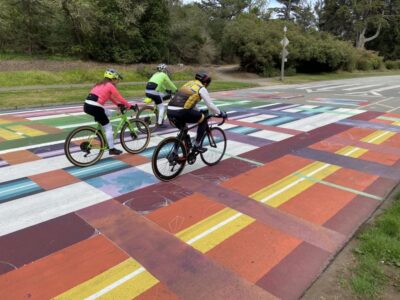 What happens when you close down a city street to cars? More people do non-driving things, like walking, biking, strolling, skating and frolicking in the space normally reserved for motor vehicles. Car-free advocates would say that as greenhouse gas emissions and traffic violence go down, happiness and connection go up — it’s hard to connect with your neighbors while ensconced in two tons of steel.
 We may be slowly returning to our offices (more or less), but the strains of the pandemic are hardly over. As we enter a transitional stage after almost two years of trauma and strain, more than ever we need ways to refresh our energies, calm our anxieties, and nurse our well-being. One potentially powerful intervention is rarely talked about in the workplace: The cultivation of experiences of awe. Like gratitude and curiosity, awe can leave us feeling inspired and energized. It’s another tool in your toolkit and it’s now attracting increased attention due to more rigorous research.
 There is so much angst in the air these days that we may all be feeling more sensitive, exhausted or even more despondent than usual. So much so, that I feel a lot of folks are at the end of their tether, overwhelmed by the vast onslaught of confusing emotions and free-floating anxiety in the telluric atmosphere.
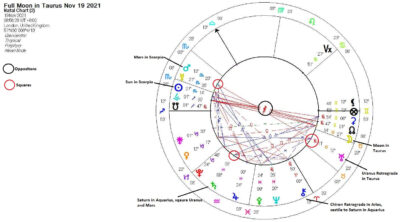 On Friday, November 19th, there will be a partial Lunar Eclipse in Scorpio-Taurus.
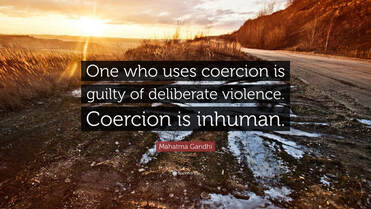 The one message anger can have for us is that our Soul Core is alerting us to some person, situation or thing that violates our sense of Self, or our core values. As such, anger is then your friend, and an ally in helping you in choosing and activating healthy boundaries. In a climate such as we have now, people’s right to say “NO!” is even being taken away. To someone experiencing physical, mental or sexual abuse, we would be appalled if someone were denied the inherent right to say “NO!, that is does not feel good and I will resist!” This is when anger can give us the courage to stand up for ourselves and by saying “no” we are saying “yes” to what feels right and good for us.