
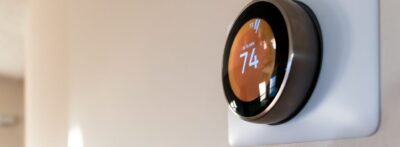
People have been fighting over who controls the temperature at home since we lived in caves. Who controls the fire? Who gets to sleep comfortably next to its burning embers on cold nights? Now we call it thermostat wars. One family member likes to crank up the AC in the summer heat, while another is putting on a sweater to be comfortable.
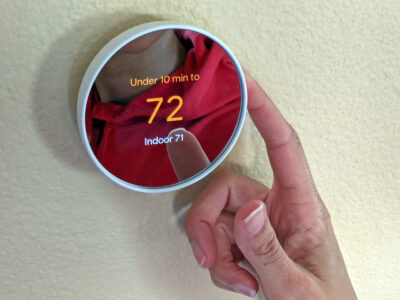
Smart home technology may be the way to end the thermostat wars. Smart thermostats can adjust the temperature room by room, and when someone is in the room or not, lower it temporarily in winter and raise it in summer, making everyone happy while keeping utility bills low.
Smart thermostats can play a role in climate change, too, by responding to peak demand — adjusting to avoid rolling blackouts and overloaded power lines that can start forest fires that take lives and property. Individual choices, house by house, make all the difference.
Our solutions to heating and cooling our homes have evolved with technology. It’s been a bumpy ride. In 2007, the Department of Energy’s extremely successful Energy Star program stopped certifying programmable thermostats—because almost no one used them consistently, and, therefore, they weren’t saving energy. Besides the energy nerds, homeowners found the thermostats too complicated to manage. It was easier to do things the old fashioned way—by changing thermostat settings during the day as needed for comfort.
In that same year, a whole new generation of smart thermostats appeared on the scene when Ecobee debuted what they called the “first smart Wi-Fi thermostat.” Nest soon followed with their own entry into the smart thermostat market. Unlike programmable thermostats, which simply allow you to schedule temperature settings throughout the days, Ecobee and Nest use artificial intelligence to figure out how to keep your home comfortable while reducing your electricity bill.
Smart thermostats can learn your day-to-day patterns and adjust the temperature for both comfort and efficiency. For example, you could set the old programmable thermostats to turn the air conditioning on and off based on time of day, such as when you are at work or late at night. The new ones add occupancy sensors to the toolbox. If you work from home one day a week or someone is staying home from school, you needn’t change all the programming, or override the system. It will happen automatically to keep you comfortable and your home efficient. Smart systems also allow slow or fast ramping up or ramping down temperatures, so that in an emergency your utility can raise your air conditioning setting in a way you won’t notice.
Beyond the Thermostat Wars
We’ve come a long way and now have programmable, communicating thermostats that connect wirelessly to phones and computers and utilities and allow remote access and control.
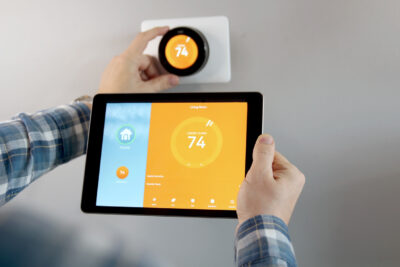 Some utilities now offer incentives to customers in exchange for the ability to control the smart thermostat when power demand is high. The utility’s control is often minimal and customers can typically override the utility setting, but a utility in Colorado recently locked thousands of customer thermostats during an “energy emergency.” If you enroll in this kind of program, be sure you understand what you may give up as a participant.
There are a few ways that working with the utility can be a win for consumers. Many utilities offer time-of-use pricing, so that electricity is cheaper at night when there is lower demand and more expensive during peak demand periods in the late afternoon and early evening. A smart thermostat can minimize your electricity use during peak demand times automatically. The rewards are lower energy bills for you, the customer, without much sacrifice of comfort.
Another way to save money during peak events is by enrolling in programs through companies that partner with utilities, like EnergyHub or OhmConnect.
So what does the utility get out of this arrangement? Quite a bit. Here are a few benefits for utilities:
- The utility’s service area will not experience as many blackouts. This goes a long way in keeping customers happy and perhaps avoiding some litigation over spoiled food and such.
- If the utility is better able to handle peak load, it will minimize the use of expensive, dirty, coal fired “peaker plants.” These are power plants that are in reserve for emergencies. They are expensive to start up and operate, and they put out a lot of CO2, NO2 and other harmful pollutants.
- By automatically shifting energy use in consumer’s homes, utilities may be able to help homeowners avoid costly upgrades to their electrical systems.
But all of these changes bring up another problem. Now that your thermostat can connect to your utility, who can see your home data? In our new connected lifestyles, can you trust your thermostat to utility program staff?
To address these issues, some states have taken steps to protect consumer privacy in the smart grid era. California, Colorado and Virginia guard against improper third party acquisition of your data for commercial purposes, such as targeted advertising. The California Consumer Privacy Act (CCPA) grants strong privacy rights, including allowing a consumer to opt out of the sale of her information to third parties, and to request that a business delete her information from its records.
Trust between utilities and their customers must be based on transparency about how energy use data is collected and stored. As the smart grid evolves, the utility industry will need to update their privacy rules to keep pace, making sure that customers always maintain control over their own data.
About the Author

Jim Gunshinan is a versatile and experienced writer and editor of nonfiction and creative nonfiction works. He writes in a conversational tone and, as a published poet, can paint pictures with words that connect and inspire. Jim blogs about, and has published articles about green homebuilding and renovation, energy, the environment, and climate change. He has also published articles on science and spirituality, personal essays, and poetry.
 While the internet had been in existence for some time, it was around the year 2000 that it became globally available to the world. Right around that time I found myself calling into play the sentience of this newly emerging global internet consciousness.
 Infinity: I sure can. I can give you several. For example, do you know that the whales of the world communicate not only with one another as a pack mind across the oceans of the planet, but they also have been communicating with life in other forms throughout the galaxy? I’m not talking here about extraterrestrials soaring in in spaceships. I’m talking about the seed of life that is contained within every living thing. Inside that seed is a spark, a life surge if you will. That spark is a communication device unlike anything that humans have yet understood. It’s how the mycelium networks work in communication with the trees, leaves and grasses of the world. It’s how the oceans are one mind, weaving and dancing their awesome endeavours into many facets to aid life wherever it is needed.
 At this point, it’s obvious that our smartphones and computers are data-leakers. Plenty of us now cover our laptops’ webcams (although we always forget about the mics), while our smartphones track our locations with us wherever we go. Unfortunately, these tools are so indispensable in modern life, we accept the privacy hit in order to function with the rest of society, and do what we can to keep our data secure.
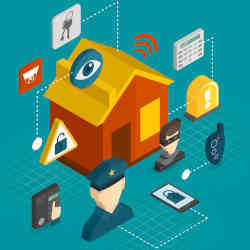 From a privacy perspective, these settings pages are essential to comb through if you want to limit the amount of data you’re feeding your smart home. Don’t forget to check the systems setting for the app as well: On iPhone, for example, you need to go to the app’s name in Settings to find additional privacy settings, including network connections like Bluetooth, Local Network, and Cellular Data. If I could, I would disable all these connections for my smart lights, but then, unfortunately, I wouldn’t be able to adjust my lights from my phone, defeating the purpose. (Although I don’t give them my location, so that’s something, right?)