

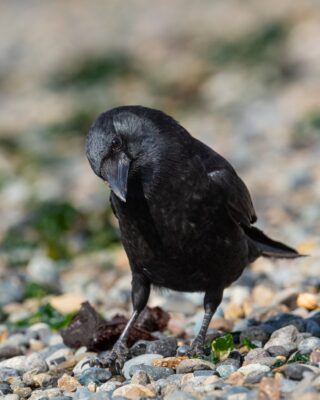
 In what now feels like an annual update, crows are even more surprisingly smart than we thought. But do they have true consciousness? Research shows that crows and other corvids “know what they know and can ponder the content of their own minds,” according to STAT. This is considered a cornerstone of self-awareness and shared by just a handful of animal species besides humans.
In new research published in Science, German scientists put crows through a series of puzzling tasks. During those tasks, the scientists measured neural activity in different kinds of neurons with the goal of tracking how crows were sensing and reasoning through their work. They sought to study a specific kind of thinking called sensory consciousness, and they chose birds in particular as an evolutionary history pivot.
The task is simple, but involves some high-level brain stuff:
“After the crow initiated a trial, a brief visual stimulus of variable intensity appeared. After a delay period, a rule cue informed the crow how to respond if it had seen or had not seen the stimulus. [A] red cue required a response for stimulus detection (“yes”), whereas a blue cue prohibited a response for stimulus detection.”
“Sensory consciousness, the ability to have subjective experience that can be explicitly accessed and thus reported, arises from brain processes that emerged through evolutionary history,” the researchers write. “Today, the neural correlates of consciousness are primarily associated with the workings of the primate cerebral cortex, a part of the telencephalic pallium that is laminar in organization. Birds, by contrast, have evolved a different pallium since they diverged from the mammalian lineage 320 million years ago.”
The birds performed in a way that affirms their sensory consciousness, which scientists say could mean the “neural correlates of consciousness” date back to at least the last time birds and mammals shared that brain section:
“To reconcile sensory consciousness in birds and mammals, one scenario would postulate that birds and mammals inherited the trait of consciousness from their last-common ancestor. If true, this would date the evolution of consciousness back to at least 320 million years when reptiles and birds on the one hand, and mammals on the other hand, evolved from the last common stem-amniotic ancestor.”
In an analysis in the same issue of Science, another researcher, Suzana Herculano-Houzel of Vanderbilt University, makes a critique of the study’s hypothesis. The structure being studied, she says, could resemble another structure because of physical properties more than a shared evolution or an indication of extremely early consciousness. The size of the structures matter a great deal, too.
“[T]he level of that complexity, and the extent to which new meanings and possibilities arise, should still scale with the number of units in the system,” Herculano-Houzel explains. “This would be analogous to the combined achievements of the human species when it consisted of just a few thousand individuals, versus the considerable achievements of 7 billion today.”
Original article here
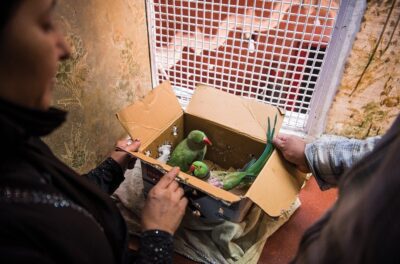
 Amid the human crush of Old Delhi, on the edge of a medieval bazaar, a red structure with cages on its roof rises three stories above the labyrinth of neon-lit stalls and narrow alleyways, its top floor emblazoned with two words: birds hospital.
 I’d come to the bird hospital, and to India, to see firsthand the Jains’ moral system at work in the world. Jains make up less than 1 percent of India’s population. Despite millennia spent criticizing the Hindu majority, the Jains have sometimes gained the ear of power. During the 13th century, they converted a Hindu king, and persuaded him to enact the subcontinent’s first animal-welfare laws. There is evidence that the Jains influenced the Buddha himself. And when Gandhi developed his most radical ideas about nonviolence, a Jain friend played philosophical muse.
 In the West, consciousness was long thought to be a divine gift bestowed solely on humans. Western philosophers historically conceived of nonhuman animals as unfeeling automatons. Even after Darwin demonstrated our kinship with animals, many scientists believed that the evolution of consciousness was a recent event. They thought the first mind sparked awake sometime after we split from chimps and bonobos. In his 1976 book, The Origin of Consciousness in the Breakdown of the Bicameral Mind, Julian Jaynes argued that it was later still. He said the development of language led us, like Virgil, into the deep cognitive states capable of constructing experiential worlds.
 Crows are not among the shoulder-perchers, but Singh sometimes sees former crow patients hovering around the hospital. They might be looking for him. Crows recognize individual human faces. They are known to blare vicious caws at people they dislike, but for favored humans, they sometimes leave gifts—buttons or shiny bits of glass—where the person will be sure to notice, like votive offerings.
 The trail was only 50 miles from Gir National Park, where, the day before, I’d seen two Asiatic lions, nearly indistinguishable cousins of Africa’s lions. Once the region’s apex predator, the Asiatic lion almost went extinct during the British empire’s colonization of India, when no viceroy could visit a maharaja’s palace without a hunt in the local forest. Even today, the Asiatic lion still ranks among the rarest of the large feline predators, rarer even than its neighbor to the north, the snow leopard, which is so scarce that a glimpse of one padding down a jagged Himalayan crag is said to consummate a spiritual pilgrimage.
 The monk was a white dot some six switchbacks up by the time I hopped off the wall and continued the climb, my legs stiffened by the break. I reached the entrance to the temple complex with only 15 minutes to spare. Its marble courtyard shone brilliant white, as though bleached by the mountain sun.